A study of the references 5000, 5028, 5026, 6000 and 6006
Few Patek Philippe references are as quietly distinctive as the family of watches that carry their small seconds at four o’clock. It began with the ref. 5000 in 1991, a white gold watch with a black dial that looked like nothing else in the catalog at the time, and it continued through the refs. 5028, 5026, 6000, and 6006. What unites them all is the automatic caliber 240, the thin micro-rotor movement whose architecture pushes the running seconds off-center and gives every watch in the line its characteristic small seconds at four o’clock. These are watches that reward a closer look, and they occupy a curious place in the collecting world, admired by those who know them and often overlooked by those who do not.
The story behind them is just as interesting as the watches themselves. It involves a collaboration with Ferrari that came very close to happening and then quietly fell apart, a commercial team given three years to sell a thousand watches nobody had asked for, and a design language that Patek Philippe would return to again and again over nearly thirty years.
This article traces the full lineage of the “Eccentric Seconds” watches, from the radical ref. 5000 through its modern reinterpretations, examining their design, their movements, their special orders, and what collectors should look for when seeking one out. Along the way it draws on auction records and production estimates to give a sense of just how rare these pieces truly are, and why any of them can hold a special place in a Patek Philippe collection.
An unusual small seconds position and the collaboration that never was
The choice to display the small seconds at four o’clock remains a mystery. Historically, Patek Philippe made a handful of pocket watches with off-center small seconds, like no. 7723, a quarter repeater with small seconds at 10 o’clock sold in 1854, or no. 12365 with small seconds at 8 o’clock sold in 1857. The latter, when looking at it if 12 o’clock was at the crown, would probably be the closest thing to having a small seconds positioned at four o’clock. However, Patek Philippe never referenced these pocket watches when introducing the ref. 5000. They might do so one day, but as of today it remains speculation.

Early pocket watches with unusual small seconds placement: no. 7723 sold in 1854 with small seconds at 10 o’clock (left) and no.
12365 sold in 1857 with small seconds at 8 o’clock (right). Image credit: Patek Philippe Genève, Huber & Banbery
What Patek Philippe confirmed, though, is the fascinating origin story of the ref. 5000. As Nick Foulkes recalls in the Patek Philippe Magazine volume V number 2, renowned carmaker Ferrari approached Patek Philippe in the late 1980s to design a watch they could gift to clients who purchased a new car. The Patek Philippe designers went to the drawing board and, likely taking inspiration from 1950s Ferrari dashboards, designed the ref. 5000 with Arabic numerals in a modern font, an inner minutes track with triangles marking every 5 minutes, and white hands. The Ferrari team liked the watch but was adamant about having the Ferrari name and logo on the dial, as well as the name engraved on the back. Mr. Stern only wanted the Ferrari name written once on the dial and no logo. The Ferrari executives refused to compromise, and in typical Philippe Stern manner he said, “No problem. We are done.” Patek Philippe had a beautiful watch and would introduce it into its collection under its own name. That was the end of a collaboration that never was.

A likely source of design inspiration: dashboard of a Ferrari 250 Testa Rossa. Image credit: Petrolicious
Ferrari’s newly appointed President Luca di Montezemolo wanted to expand Ferrari’s merchandise footprint and then turned to Girard-Perregaux for watches. Mr. Luigi “Gino” Macaluso, a Turin native and former rally car champion, had fully taken over Girard-Perregaux in 1992. The friendship between the two CEOs and their shared vision sparked a partnership that lasted a decade until 2004.
Patek Philippe, by contrast, has effectively avoided co-branded partnerships, preserving its full independence, protecting its brand equity from dilution, and keeping the focus on its own identity.
A radical design
Ref. 5000 was presented at Baselworld in 1991. It was radically different from the rest of the catalog. The offering at the time was remarkably classic: Calatrava watches in yellow gold with silver dials, Ellipses in yellow gold with silver or blue dials, and the smaller Nautilus refs. 3800 and 3900—after the original ref. 3700 had been discontinued. The bestselling model, by quite a margin, was the ultra-classical ref. 3919.

HSWA’s Patek Philippe 1992 product catalogue for the US market. Made in white gold with a black dial, ref. 5000 stands out against all classical watches. Image credit: Patek Philippe
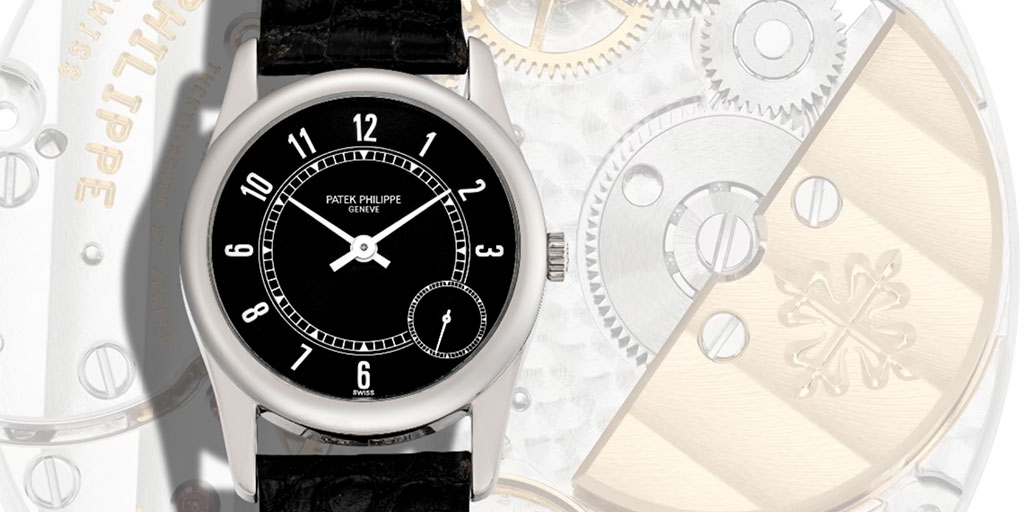
The ref. 5000 came in stark contrast: a white gold watch with a black dial, modern printed Arabic numerals, and an exotic small seconds at four o’clock. The 33 mm case had a relatively simple design and was bulkier than other Calatrava watches, almost muscular by comparison. It also had two avant-garde elements that were a rarity at the time: a sapphire case back and a deployant buckle. Only Haute Horlogerie pieces had these back then, and now both are ubiquitous.
A beloved collector feature, though not many know of it, is the set of large gold hallmarks. They are unusually located between the lugs at 6 o’clock and often not very visible due to the angle pictures are generally taken from. These arguably add a lot of charm to the case.

expect from a 33mm watch. Image credit: Sotheby’s
This was clearly not a watch the market had asked for. Mr. Stern had decided a batch of 1,000 pieces had to be made in order to keep the watch as an entry-level model within the catalog. One thousand pieces was a huge number for a single reference, given that Patek Philippe was making about 15,000 watches per year at the time. Internally, the commercial department strongly pushed back, saying there was no market for such a piece. The compromise was that the commercial team was given three years to sell all the watches.
The 1,000 pieces were produced in 1992 and 1993 and sold pretty well. It wasn’t a bestseller, but the watches did not sit unsold in retailers’ showcases for years either. Patek Philippe had discovered that a different type of watch could be made to target a different audience.
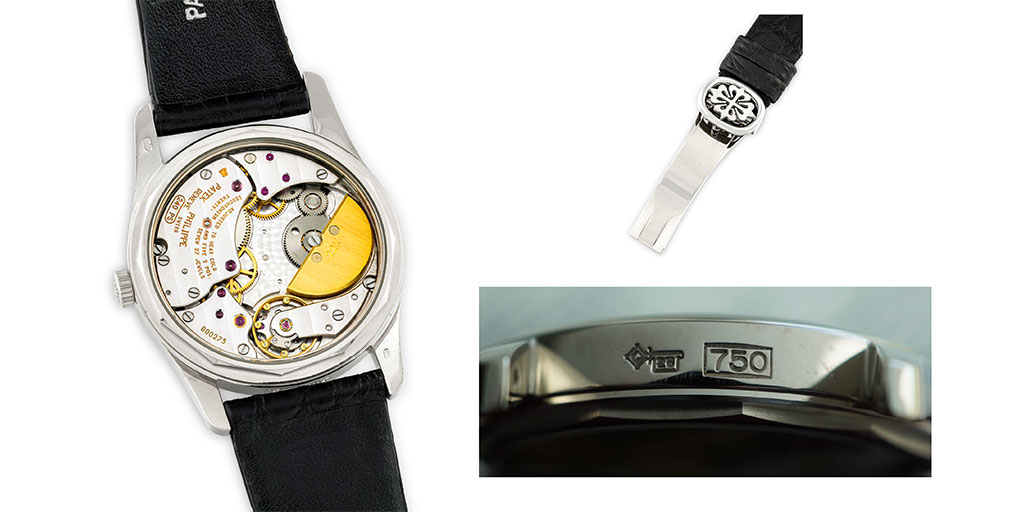
The sapphire case back and deployant buckle were novel features for regular production watches, which are now ubiquitous. Note
the oval shaped buckle, which was only available on the white gold version. The large hallmarks between the lugs are a nice extra feature. Image credits: Christie’s (watch, buckle), Timeless vintage (hallmarks)
A few years later, in 1997, the initial ref. 5000 in white gold with a black dial was followed by a watch with a very similar design and dial layout: the Ellipse ref. 5028G. It was also powered by the automatic caliber 240 PS. Having a sporty-leaning dial with an eccentric small seconds in an elongated oval case shape was even more unusual. Maybe a little too unusual. The watch, made only in a single variation, was a much harder sell, and it was produced in far smaller numbers than the original ref. 5000 before being officially discontinued in 2003.
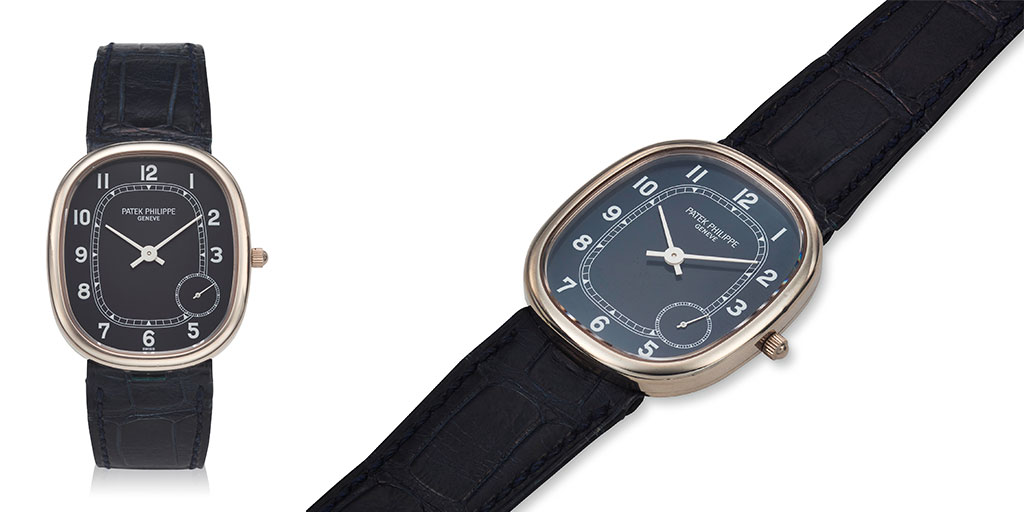
The ref. 5028 Ellipse sharing the same design language as ref. 5000. Less than 500 pieces were produced. Image credit: Collectability Archives
The retreat to tradition
The tension between tradition and modernity was palpable in the evolution of ref. 5000 and ref. 5026, which was introduced in 1997.
The white gold ref. 5000 was followed by a yellow gold version mostly made between 1994 and 1996. The yellow gold version had a dramatic look with its contrasting black dial. It featured applied numerals, adding an extra decorative element. The sigma signs on either side of the SWISS printing at 6 o’clock indicate the numerals were made in gold. That same striking color combination would be used for the 1998 oversized 42 mm ref. 5070 chronograph.
The rose gold ref. 5000R was introduced into the collection in 1996 and features a pink dial, a combination collectors nickname “pink-on-pink.” It retains the overall design with applied numerals, but the leaf (feuille in French) hands make for a much more traditional look, showing the inherent tension between modern and classical.

Ref. 5000J with its contrasting black dial against the yellow gold case, and the pink on pink ref. 5000R. Image credit: Christie’s
That tension was further accentuated when Patek Philippe presented the lesser-known 33 mm ref. 5026 in 1997. In contrast to the ref. 5000, its case is much more refined and classical: the lugs are slimmer and gently turn downward, the case band is satin-finished, the bezel is polished, and it also comes with a sapphire back. All dials follow the same design pattern, with the small seconds at four o’clock, Breguet numerals, and Breguet hands. It was available in all four precious metals from the start: yellow and rose gold with either a silver or black dial; white gold with a black dial; and platinum with a slate dial. The ref. 5026 is a rare sight at auctions, and one can estimate that only a few hundred were made (excluding the limited edition Millennium set).
Patek Philippe officially discontinued the ref. 5026 in 2002, and the refs. 5000 and 5028 in 2003. However, most of them had no longer been produced, or only sporadically, for many years prior due to diminishing demand, as the taste of the time was leaning toward larger watches and away from very classical designs.

The elegant case profile of ref. 5026. Image credit: Sotheby’s

Some variations of ref. 5026 in platinum, yellow and rose gold. The Breguet numerals and hands mark a return to the traditional
Calatrava design language. Image credits: Christie’s, Sotheby’s
The modern reinterpretation
The introduction of the ref. 6000 in 2005 marked the return of an “Eccentric Seconds” watch to the catalog, and the overall design was very much inspired by the first ref. 5000. Made in a more contemporary style, though certainly not oversized, the case was enlarged to 37 mm and the automotive inspiration was fully kept. The black dial of the ref. 6000G-001 retained the small seconds placement, inner circle marking the minutes with its distinctive triangles every 5 minutes, Arabic numerals, and hand design. The increased size also allowed for a very practical date on the outer circumference of the dial. An extra hand with a distinctive red end section shows the date. The caliber powering the ref. 6000 was still based on the celebrated 240, except that it was now named 240 PS C, the C standing for calendar.
The reception, as with the ref. 5000, was mixed. Some loved it for being different and adding a touch of originality and modernity, while others thought the dial was not harmonious and overloaded with information. This led to the watch being discontinued after just two years, in 2007.

Introduced in 2005, ref. 6000G-001 builds on the design language of ref. 5000, while adding a practical date in the more
contemporary 37mm case. Image credit: Timeless vintage
In 2007, Patek Philippe introduced a new dial variation. The two-tone gray dial of ref. 6000G-010 featured the same general layout; however, the inner minute track and small seconds sub-dial were cream and delicately guilloché, adding extra contrast and making for a much more vibrant dial. This version was much better received and remained in the catalog until 2015, the longest production run of any watch in the “Eccentric Seconds” lineage.
The ref. 6000 line was completed by the ref. 6000R-001, a rose gold variant with a brown dial, in 2011, and the ref. 6000G-012 in white gold with a blue dial, which was an end-of-series run before the model was discontinued in 2016.
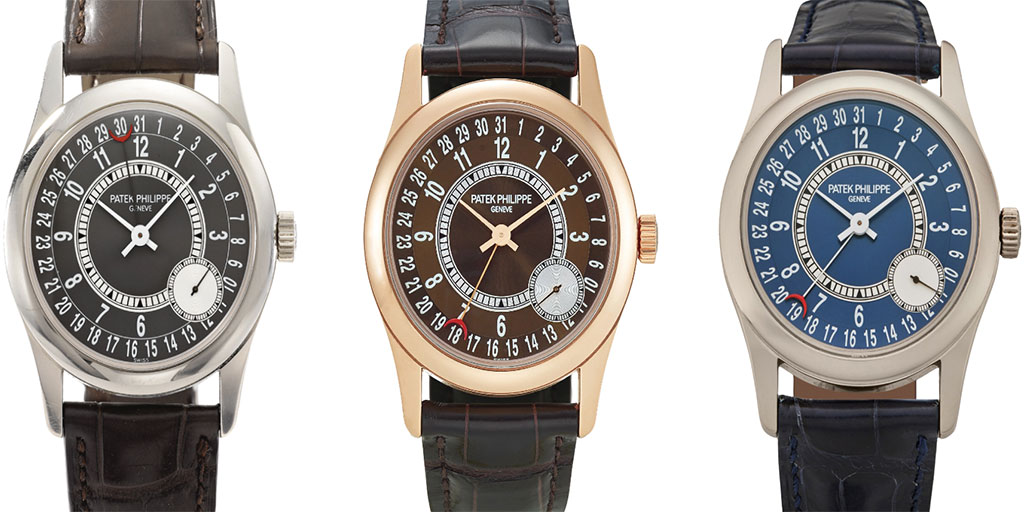
The subsequent ref. 6000 with two tone dial design, left to right: ref. 6000G-010 grey dial, ref. 6000R-001 brown dial and ref. 6000G-012 blue dial. Image credits: Christie’s, Sotheby’s
To mark the 40th anniversary of caliber 240 in 2017, Patek Philippe introduced ref. 6006G-001. With a modernized 39 mm case, the watch featured a two-tone black dial. As such, it is an evolution of the previous design iteration introduced with the gray-dial ref. 6000G, keeping its sophistication while returning to the original black color from 1991. The center is black with a fine sunburst finish, while the silvery minute circle is delicately guilloché. The outer edge with the date circle has a sunburst pattern, while the hour circle is guilloché. The white-lacquered baton-style hands were changed to skeletonized hands, while the date hand now has a red arrow tip.

Ref. 6006G-001 in a 39mm case with black dial, date and skeletonized hands. Image credit: Patek Philippe
Ref. 6006 was discontinued after just three years of production, in 2020, when it was replaced by ref. 6007A, a contemporary interpretation of the Calatrava in steel made to mark the inauguration of the new manufacturing building in Plan-les-Ouates, Geneva. The steel model was later followed by gold variants, which are still in the catalog. While the ref. 6007 has lost the four o’clock seconds sub-dial in favor of a more traditional central seconds and date, the spirit of the initial ref. 5000 and its lineage lives on to this day within the Calatrava collection.
Special editions
During its almost 30-year production period, a few special orders have been made, all celebrating notable occasions. While Patek Philippe has publicly communicated about some of these special orders, there is often no public information, and as a result more pieces might still be discovered.
Ref. 6000T-001 “Children Action”
Titanium is arguably the rarest metal used by Patek Philippe. A unique piece of the ref. 6000 in titanium with a two-tone black and gray dial was made for the Geneva-based charity Children Action in 2007. It was auctioned off during the gala dinner, and the CHF 500,000 it achieved was donated to the charity. The watch was auctioned again by Phillips in Hong Kong in 2016 and remains the most expensive “Eccentric Seconds” lineage piece ever sold. Patek Philippe has continually crafted one-off pieces for Children Action since 2005 and has helped raise a total of CHF 22 million for the charity to date.

Ref. 6000T-001 “Children Action” unique piece in titanium. Image credits: Antiquorum, Phillips
Ref. 5000F Hausmann & Co.
In 1994, Patek Philippe celebrated the bicentenary of the historic retailer Hausmann & Co. in Rome, Italy, with a 100-piece limited edition, the ref. 5000F (with F being unconventionally used instead of the usual R for rose gold). The timepiece features a silver dial with Breguet numerals and Breguet hands, bringing a very traditional style, with just the small seconds at four o’clock adding a touch of Italian sprezzatura, a studied nonchalance with a lot of style. The plain case back reads “Hausmann & Co. 1794 – Roma – 1994.” A complete study of retailer anniversary pieces can be found in this article.

Ref. 5000F made for the bicentenary of retailer Hausmann & Co in Rome, Italy. Image credit: Sotheby’s
Ref. 5026R “Macau handover”
In 1999, Patek Philippe made 30 pieces in rose gold to mark the handover of Macau from Portuguese to Chinese administration. The dial is based on the traditional layout with Breguet numerals and hands, made distinct by a circle between 7 and 8, symmetrical to the small seconds sub-dial, bearing the inscription “20 December 1999,” the official handover date.
Ref. 6000G and 6000R “10th Anniversary in China”
Patek Philippe made two limited editions of the Calatrava ref. 6000 to commemorate the 10th anniversary of its presence in China, both released in 2015 in editions of 25 pieces each. The refs. 6000G-013 and 6000R-010 feature a silver dial, on which the hour numerals have been replaced by indexes. The plain case back bears an engraved map of China with Beijing and Shanghai marked in Chinese characters.

Left: ref. 5026 “Macau handover” limited to 30 pieces. Image credit: Phillips. Right: ref. 6000 “10th Anniversary in China”, available in rose and white gold, in 25 pieces each. Image credits: Christie’s, Phillips
Ref. 5026 “Millennium set”
To celebrate the new millennium in 2000, Patek Philippe released several limited editions across its different model lines. In the Calatrava line, the ref. 5026 was chosen. Each set contained one piece in each precious metal made with Roman numerals: yellow gold with a silver dial, rose gold with slate, white gold with blue, and platinum with black. Reportedly, though Patek Philippe will not confirm this number, 130 sets were made, with the four watches sold together in a leather briefcase. Finding a complete set with its briefcase is becoming increasingly rare, as many sets have been broken up over the years.
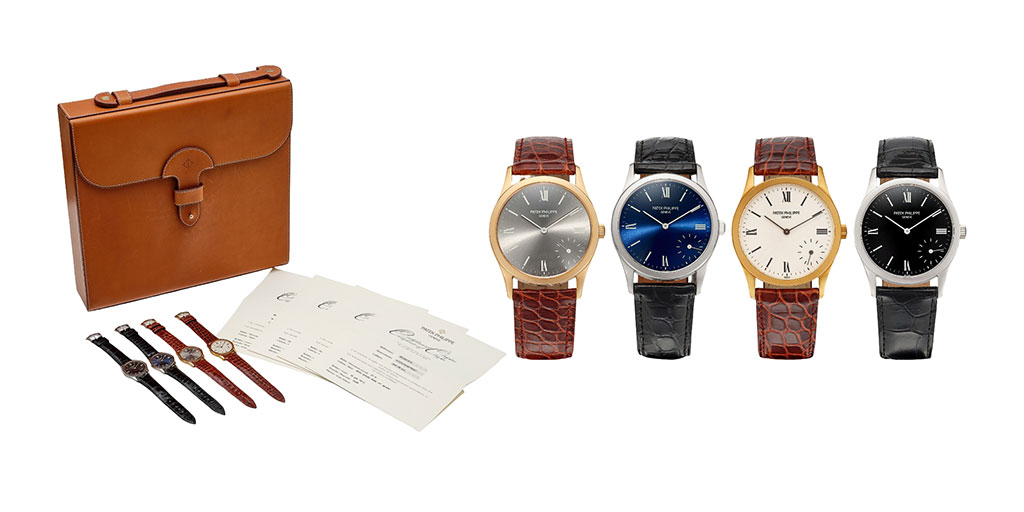
Ref. 5026 Millennium set with original leather briefcase. Image credit: Sotheby’s
Ref. 5000, 6000 and 6006 with Tiffany stamp
Tiffany & Co. is the only retailer worldwide known to receive watches bearing the additional retailer signature on the dial for refs. 5000, 6000, and 6006. Only a handful of each have appeared at auction, and they command a slight premium.
Collectability
Any of the “Eccentric Seconds” pieces will hold a special place in a Patek Philippe collection, as they have that extra little something other classical Calatrava watches sometimes lack.
Ref. 5000
As of June 2026, the ref. 5000 has been sold 165 times at the international auction houses Antiquorum, Christie’s, Phillips, and Sotheby’s, representing 144 unique examples once those sold multiple times are removed. Based on back-to-market coefficients (the historical rate at which a given reference resurfaces at auction), we can extrapolate that approximately 1,700–2,000 pieces have been made, with the breakdown by metal below. Importantly, these findings are based on empirical research, and Patek Philippe will not confirm these numbers, so these estimates may be updated as new evidence emerges.

Each of the models has its own charm: the white gold for being the original release; the yellow gold with its strong contrasting black dial; the rose gold with the pink-on-pink aesthetic; and the strictly limited Hausmann with the touch of sprezzatura. What is undisputed is that the ref. 5000 is a rare watch, made in small numbers for a time-only model.
As with all vintage watches, collectors are highly encouraged to request an Extract from the Archives, which will certify how the watch was first made and when it was produced and sold. Full-set examples are very rare, as the watches were considered entry-level pieces for Patek Philippe at the time and less attention was given to keeping paperwork and boxes. A complete set should command a premium.
And above all, collectors are encouraged to seek the best-preserved examples they can find. An advantage here is that, due to the simple case design, the watch can take a light polish without losing its shape, and as the main hallmarks are between the lugs, they are generally preserved. That said, if scratches are too deep or the watch is polished too often, it might lose some of its appeal.

While prices reached a temporary high in the late 2000s, they subsequently retreated until about the early 2020s, when they began to rise again slightly. Although the white gold had historically commanded a premium despite being the most produced, in recent years white and yellow gold sell for similar amounts, while the rose gold sells for a little less despite its rarity. All that said, very good examples can be found below $20,000, and though certainly not cheap, they represent a lot of value for the money in the world of Patek Philippe.
Other references of the “Eccentric Seconds” lineage
For the other references, the auction results are often too scarce, or the watches have not been on the market long enough to draw more precise conclusions, and any production numbers would be too speculative.
The ref. 5028 Ellipse is a rare sight at auctions: it has appeared only nine times since 2000 at major international auctions. This is partly due to moderate demand at these auctions and partly due to its inherent rarity. It is appreciated for its distinctive look and is arguably the sportiest Ellipse.
The ref. 5026 is rare and was produced in very small numbers, across several different dials. Collectors like it for its classic look, with the beloved Breguet numerals and a small twist.
The refs. 6000 and 6006 will be interesting to follow in the coming years. Only a few different variants have been made, which generally makes the line easier to collect. Their size gives them contemporary appeal, as some collectors consider the ref. 5000 to be too much of a vintage statement with its 33 mm case. They combine a strong vintage inspiration with the comfort and reliability of a modern watch. As both are more modern watches, collectors are encouraged to seek complete examples with a Certificate of Origin and box to tell the complete history of the watch, and to look for the best possible condition. The ref. 6000G-012 (blue dial) is generally the most sought after and commands a premium. All other variations currently trade for similar prices.
Conclusion
The “Eccentric Seconds” watches occupy a special place in Patek Philippe’s history. They began as an experiment, a radical departure introduced almost against the wishes of the commercial team, and they proved that the manufacture could speak to a different kind of collector without straying from its own standards. Across nearly thirty years of quiet evolution, from the initial ref. 5000 to the more modern ref. 6006, they carried an automotive spirit, an unusual small seconds placement, and the celebrated caliber 240 through every iteration. They were never bestsellers, and that is part of their charm. For the collector who appreciates something a little different within an otherwise classical brand, any of these references offers a rare combination of originality, mechanical pedigree, and understated presence.
That spirit did not end with the ref. 6006. In 2020 Patek Philippe introduced the ref. 6007, first in steel to celebrate the opening of the new manufacturing building in Plan-les-Ouates, and later in gold variants that remain in the collection today. The small seconds moved back to the center and the four o’clock layout was set aside, yet the contemporary sensibility that began with the ref. 5000 in 1991 lives on in these watches, appealing to clients who want a Calatrava with a more modern character. The line that started with a Ferrari commission that never was continues to shape how Patek Philippe approaches its most classical collection, a quiet influence that shows no sign of fading.
Edouard Henn has been passionate about horology since his teenage years. He began his professional journey in the watch industry in Switzerland before transitioning to luxury retail across Europe and the Middle East. With a business education background, Edouard brings both product and collector’s perspective to his writing. Now based between Geneva and Paris, he enjoys sharing horological knowledge and connecting with fellow enthusiasts in the watch community.