If anyone, privileged to have met Philippe Stern was asked to define him, they would most likely say: “A gentleman”. I’ve had the pleasure of working with him and the word I would use to describe him is “humble”. He also had a wonderful, dry sense of humor, but that was not something that most people knew. Instead, they saw a hardworking man who cared as much about preserving the heritage and unique level of watchmaking at his company, Patek Philippe, as the people who worked for it.
I first met Philippe Stern in 1988. I was a young, low-level PR girl, but he treated me with as much respect as a visiting dignitary. Mr. Stern, as everyone referred to him, was polite and unassuming. He listened. And he remembered. When I started working in-house at Patek Philippe in 1992, he read every fax that came into the office from around the world. One year, during a visit to Geneva, he asked if I was going to see my sister in Verbier (he read this in a fax about hotel reservations). I said I was and he invited me to dinner at his chalet in Verbier as he and his wife Gerdi would be there the same weekend. We had a lovely dinner, and after, when he kindly drove me back to my sister’s house, he said to his wife: “Have a good evening, I’ll see you tomorrow.” There’s the wonderful, dry sense of humor. We all laughed!
Without Philippe Stern and his extraordinary legacy, it is hard to imagine that Patek Philippe would exist in the same way that it does today. He was pivotal not only in preserving the heritage of the company with the Patek Philippe Museum, but also preserving the economic future of the company by solidifying all the workshops in an at-the-time obscure suburb outside Geneva; introducing new complications and movements that would continue to differentiate Patek Philippe from any other watchmaker; support artisans such as enamellers and engravers when there was no market for their skills; market the company to a level of awareness and appreciation few luxury brands have achieved; and doggedly pursue perfection.
Around 1994, Mr. Stern drove me to some fields in Plan-les-Ouates and explained, as we stood on the large expanse of a concrete base, that this was where he was going to build the future of Patek Philippe: the new workshops. “I must preserve the future of the company, and we won’t survive operating as we do in thirteen scattered workshops. We all need to interact”. On the property was a dilapidated, once grand building that was now barely standing. “We shall renovate the château and entertain retailers there,” he said confidently. What an enormous undertaking I thought. What a very brave man to move several hundred watchmakers who had been visiting their favorite local bistros in town at lunchtime for decades. Good luck with that! But he did it, and as we now know, all the other major watchmakers followed Patek Philippe to a field of dreams in Plan-les-Ouates.
When I started working at Patek Philippe in New York, I was responsible for marketing in the USA. I soon got frustrated by the fact that most people had never even heard of the company. “Pateeki Philipee? Patrick Philip? What does that do?” was the most common response when I told people, and advertisers where I worked. Fortunately, in the mid 1990s, Patek Philippe was a small company, and I could see Philippe Stern regularly on visits to Geneva. And I would ask him the same question, “When can we change our advertising?” This was the last thing he wanted to do having already invested heavily in marketing the 150th anniversary in 1989, building a new, state-of-the-art workshop complex, introducing new movements and horological inventions, and building a world-class museum. But I kept nagging him and eventually he said, “If you think you can do better, Mrs. Edwards, please go-head.” Thank you, I will! The story of how the tag line ‘You never actually own a Patek, you merely take care of it for the next generation’ was created is well documented. What is not, is the support that Philippe Stern gave to me and the marketing team. He never questioned why we decided to go to London to find a new ad agency rather than stay within Switzerland as all Swiss companies did. He had total belief in his staff and knew that moving forward meant taking risks, something he had done repeatedly in his storied career. In the end, three advertising agencies flew from London to present their new ad campaigns. Mr. Stern sat quietly and politely next to me through each presentation. The last presentation was by Leagas Delaney and when they held up a board with the now iconic tag line, my eyes teared up, I knew it was right. Mr. Stern simply said quietly, “C’est bien”, and the rest is history.
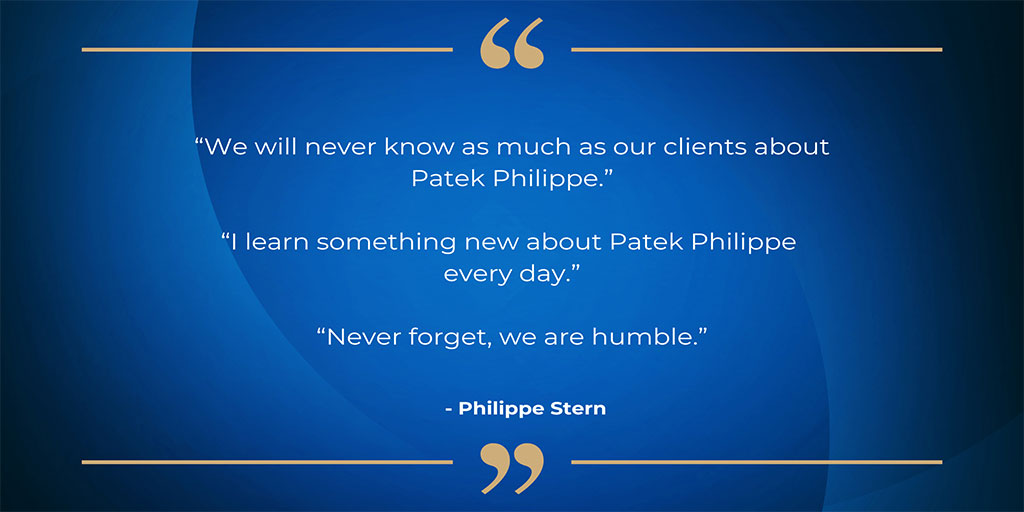
Here are three things Philippe Stern said to me over the years:
“We will never know as much as our clients about Patek Philippe.”
“I learn something new about Patek Philippe every day.”
“Never forget, we are humble.”
I am very privileged to have known and worked with Philippe Stern, a brilliant, humble gentleman.