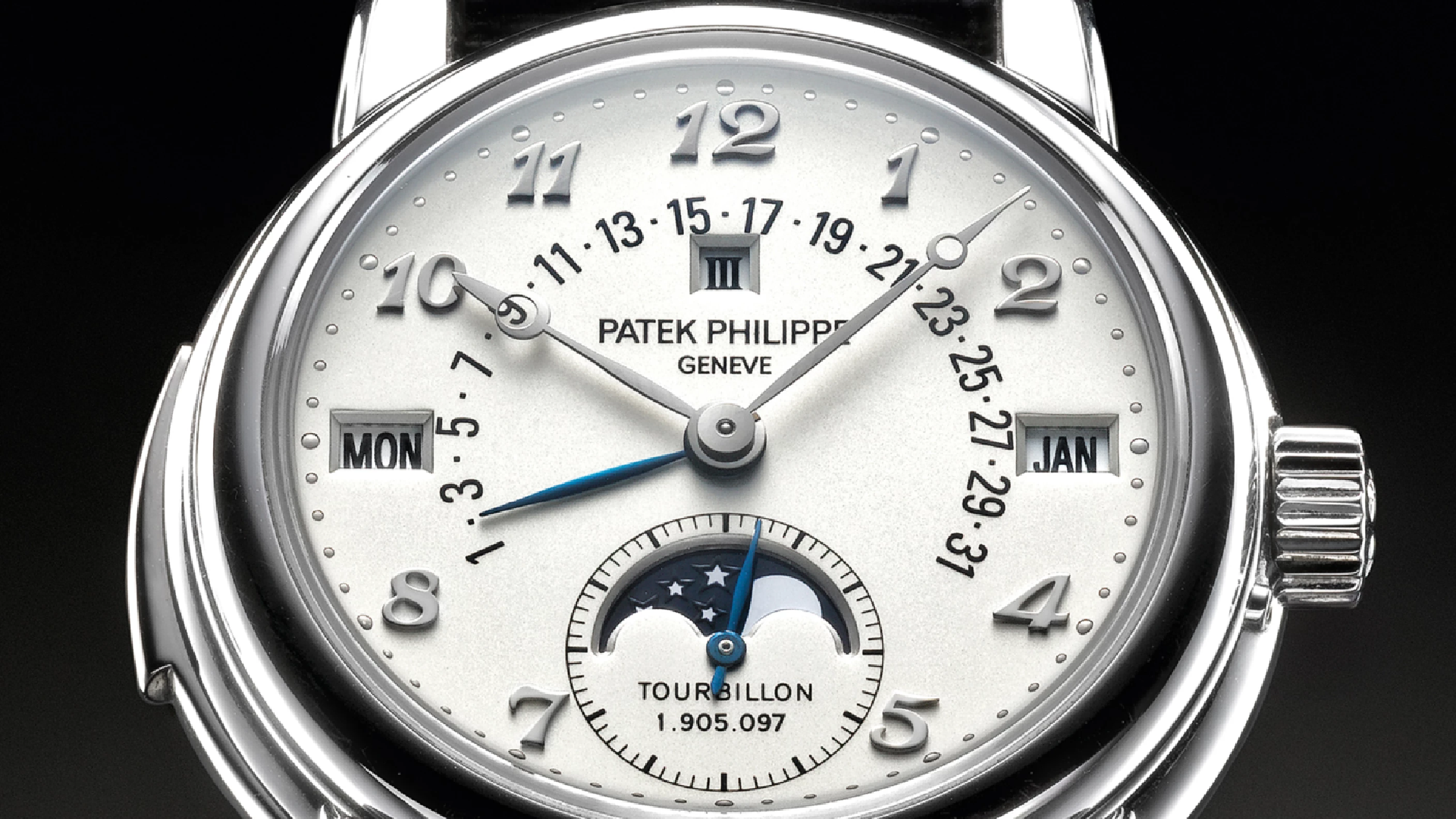
Released in 1993, the Patek Philippe ref. 5016 is often referred to as a masterpiece — and rightfully so. Few watches manage to balance the art of simplicity, extreme complexity, acoustic prowess, and visual poetry in a single offering. Combining a minute repeater, tourbillon, and retrograde perpetual calendar within a classically proportioned 36.8 mm case, it stood as Patek Philippe’s most complicated wristwatch for almost a decade.
Beyond its technical achievements, the ref. 5016 holds a defining place in Patek Philippe’s history. Conceived in the aftermath of the quartz crisis, it embodied the brand’s deliberate strategy of doubling down on Haute Horlogerie rather than competing on price and lowering its standards — a vision that would shape Patek Philippe’s identity for decades to come.
In this collector’s guide, we will examine the historical context that gave rise to the ref. 5016, study its case, dial, and movement in detail, and propose a framework of four distinct series to map the subtle evolutions that took place over its 18-year production run. We will then explore the remarkable special orders that emerged from this reference, before turning to a market analysis based on auction results, with production estimates to help collectors navigate this exceptional reference.
Historical context
To understand the importance of ref. 5016, one has to understand the context of the late 1980s/early 1990s when the watch was conceived. The Swiss watch industry was in the midst of the quartz crisis, with heavy competition from the Far East offering watches with significantly improved accuracy at a fraction of the price. Patek Philippe, true to its values, chose not to race to the bottom but rather to revert to what it was known for: making highly complicated pieces to the highest level and positioning the brand as the Haute Horlogerie leader.
The foundation for this was the Caliber 89 pocket watch, released on the occasion of Patek Philippe’s 150th anniversary in 1989. With its 33 complications, it was the most complicated timepiece of its time. This was the much-celebrated flagship piece that paved the way for the complicated wristwatches that followed.
That same year, 1989, Patek Philippe introduced ref. 3974, an automatic, minute repeater with perpetual calendar, as well as ref. 3979, an automatic, time-only minute repeater. In 1992, Patek Philippe introduced ref. 3939, a minute repeater with tourbillon, and ref. 5013, an automatic, tonneau-shaped minute repeater with retrograde perpetual calendar.

The trio of complicated watches that preceded ref. 5016: ref. 3974 Minute Repeater Perpetual Calendar (1989); ref. 3939 Minute Repeater Tourbillon (1992); ref. 5013 Minute Repeater Retrograde Perpetual Calendar (1992). Image credit: Sotheby’s, Christie’s
This retrograde perpetual calendar display allows for great legibility despite the large amount of information shown. Its layout traces back to a unique ref. 96 perpetual calendar from 1937 (no. 860,183), built on a Victorin Piguet ébauche, which featured a similar arrangement of indications. A major improvement is the addition of a leap year indication — a key feature for anyone who has attempted to set a perpetual calendar.
When Patek Philippe introduced ref. 5016 in 1993, combining a minute repeater, tourbillon, and retrograde perpetual calendar, it became the most complicated wristwatch in Patek Philippe’s offering, and would remain so for eight years, until 2001, when the ref. 5002 Sky Moon Tourbillon was introduced, which additionally incorporated a sky chart — an impressive achievement.
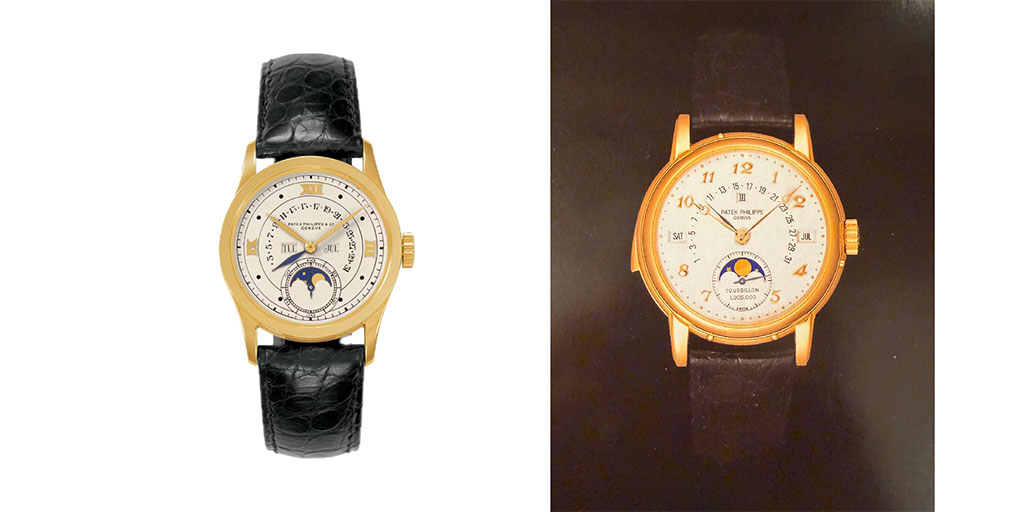
Left: unique ref. 96 with retrograde perpetual calendar (1937). Image credit: Patek Philippe.
Right: the earliest known ref. 5016 with movement number 1,905,000, as illustrated in Patek Philippe Genève Wristwatches by Martin Huber and Alan Banbery (second edition, page 331).
Case
The case of ref. 5016 is the definition of classical Patek Philippe elegance and beauty. It builds on history, deliberate incremental evolution, and a smooth integration of complications.
Measuring 36.8 mm in diameter by 13 mm in height, it features stepped lugs and a domed bezel recalling the ref. 2499. The lugs are short, arched, and welded to the case, turning down toward the wrist for wearing comfort. The minute repeater slide, recessed into the case on the left flank, seamlessly integrates into the overall design while remaining prominent enough to be easily activated.
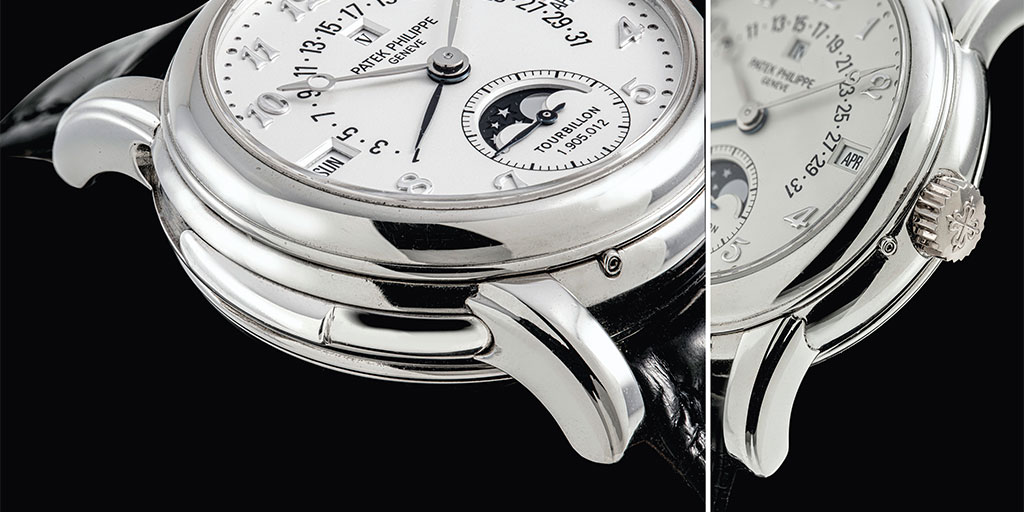
Details of the case. Note the slightly recessed areas in the lugs to accomodate the minute repeater slide. Credit: Christie’s
To allow the movement to be admired, watches were delivered with a sapphire case-back, as well as a second plain case-back as a nod to historical tradition.
Early examples were made by Jean-Pierre Hagmann, the iconic case-maker known for working on particularly complex designs. They can be recognized by the JHP initials stamped on the base of the lug. Based on models that have resurfaced at auction, one can extrapolate that approximately the first 50 examples had cases made by Hagmann — though this remains unconfirmed by Patek Philippe.
From the launch in 1993, ref. 5016 was offered in yellow, rose, and white gold, as well as platinum. A single piece in steel is known, which was made for charity (see special editions section).

Examples of cases in platinum and rose gold made by Jean-Pierre Hagmann and stamped JHP. Image credits: Phillips, Christie’s
Dial and hands
The dial achieves remarkable harmony, with each element in service of elegance, legibility, and balance.
The first characteristic is the Breguet numerals marking the hours, complemented by a classic minute track around the dial, featuring slightly larger dots for the five-minute marks. They are paired with elegant Breguet hands. The numerals, dots, and hands match the color of the case metal.
The calendar indications are displayed with apertures for the day of the week and the month at 9 and 3 o’clock respectively, while the date is displayed on a retrograde indication in the center of the dial on a 240-degree arc. The retrograde indication means that once the calendar has reached 28, 29, 30, or 31 depending on the month, it instantly jumps back to 1. The leap year indication is shown at 12, while the moon phase and small seconds are at 6. Not only is the dial highly legible, but the way each element is displayed creates a beautiful symmetry.
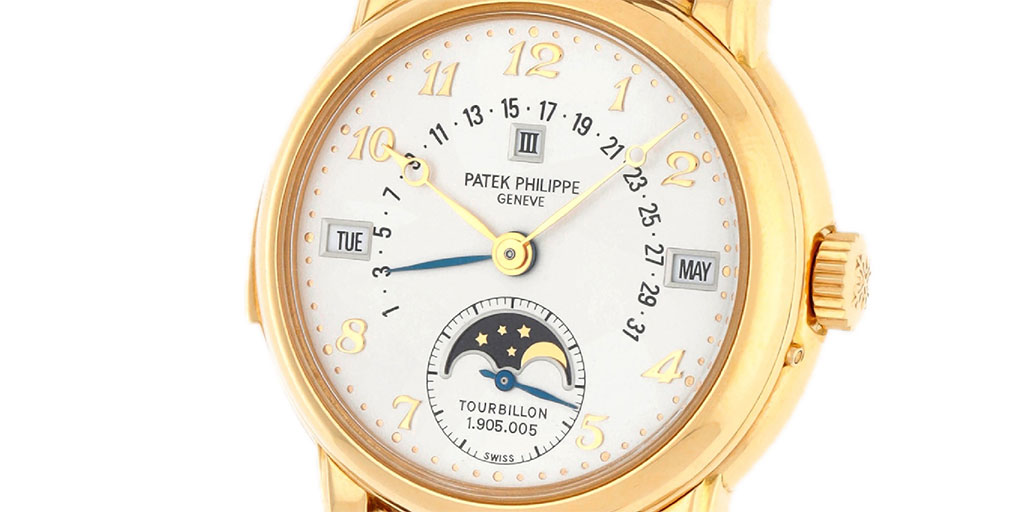
The characteristic ref. 5016 dial with Breguet numerals and hands, and symmetrical calendar and moon phases indications. Image credit: Sotheby’s
The calendar was available in English (the vast majority), as well as German, Italian, and French, all significantly rarer, adding extra storytelling — though the market doesn’t price these variants any higher.
Patek Philippe chose not to show its tourbillon on the dial side (with the notable exception of ref. 5303, introduced in 2019) and modestly printed the word “Tourbillon,” as well as the movement number, under the moon phase.
At launch, the ref. 5016 was offered with a silver opaline dial for all metals. This was followed by the introduction of an additional black dial for rose gold and platinum in the late 1990s/early 2000s.
Consistent with its policies at the time, Patek Philippe would regularly accommodate clients who asked for a second dial in another color. These extra dials would also bear the exact same movement number under the word “Tourbillon.”
Though any collector is always encouraged to request an Extract from the Archives to verify the watch’s history, these second dials were not always recorded in the Archives, and often the Certificate of Origin does not show the second dial. However, a key element for collectors to verify is that the numbers engraved on the movement and printed on the dial perfectly match. If they don’t match, it means the dial was not originally made for that specific watch, which significantly affects value.
Moon-phase
As for all other Patek Philippe references, the moon evolved subtly over time. On early examples up to ca. 1998, the moon was yellow, regardless of the case metal; afterwards, it matched the color of the case (that is, silver for white gold and platinum). Up until ca. 2008, the moon and stars were polished with a prominent black border. From then on, the moon took on a frosted finish, adding extra depth.
Movement
The movement is undeniably a work of art, showcasing the full range of Patek Philippe’s expertise in both engineering and finishing. It’s worth remembering, too, that it was designed in the late 1980s/early 1990s, when computers were still in their infancy. The fact that it emerged from countless manual calculations and hand-drawn plans makes the result all the more remarkable.
Technically, the manually wound caliber R TO 27 PS QR combines three of the most elaborate complications: a minute repeater (R), a tourbillon (TO), and a retrograde perpetual calendar (QR). The 506 parts — of which 72 are for the tourbillon, which weighs a scant 0.3 grams! — fit in a diameter of 28 mm with a height of 8.58 mm.
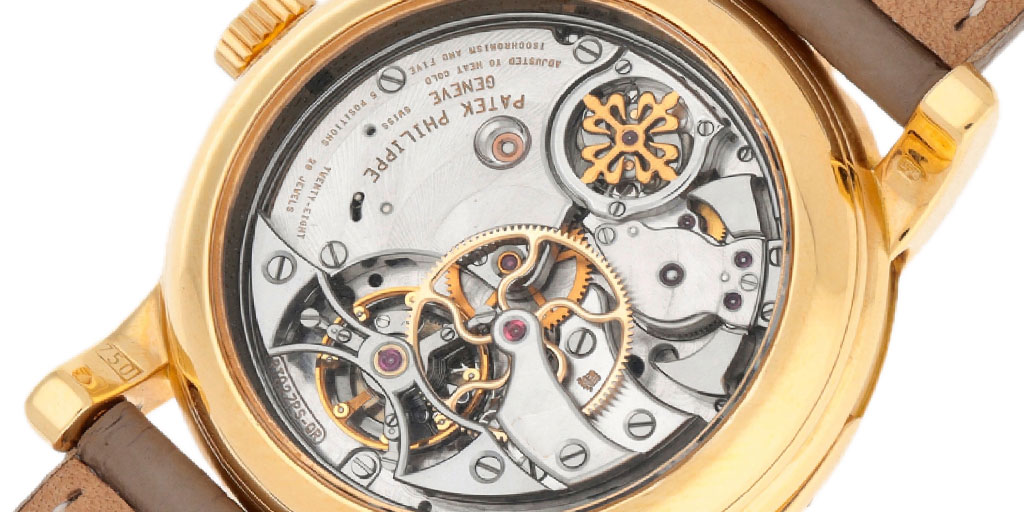
The Haute Horlogerie movement with its minute repeater, tourbillon and perpetual calendar can be admired through the sapphire case-back. Image credit: Sotheby’s
The minute repeater sounds the hours and minutes on demand by pushing up the slide on the left side of the case: the hours with low-pitched strikes, the quarter-hours with double strikes, and the minutes with high-pitched strikes. The sound is particularly clear and resonates beautifully.
True to the original spirit of the tourbillon, which is to improve rate accuracy, each watch was submitted to the independent testing authorities of the Republic and Canton of Geneva and delivered with an official rate certificate indicating the precision in each position. In that sense, the tourbillon is not a gimmick but plays an integral role.
Aesthetically, the movement is a joy to the eye and shows the talent of Patek Philippe’s watchmakers in terms of finishing. Two of the standout elements are the center wheel, with rounded, polished arms that fan out like an octopus’s tentacles, and the “bat-shaped” tourbillon bridge with its distinctive eight inner angles. These are just two standout features among many others on the movement, like the Calatrava cross of the repeater regulator or the mirror-polished minute repeater hammers. In short, this is a demonstration of Haute Horlogerie at the highest level.
From 1993 to 2010, movements bore the Geneva Seal, while movements made in 2010-11 bore the Patek Philippe Seal. The former had serial numbers starting with 1,905,xxx, while the latter had serial numbers starting with 5,000,xxx. Patek Philippe Seal watches came with a Patek Philippe accuracy certificate, rather than a Geneva testing certificate.
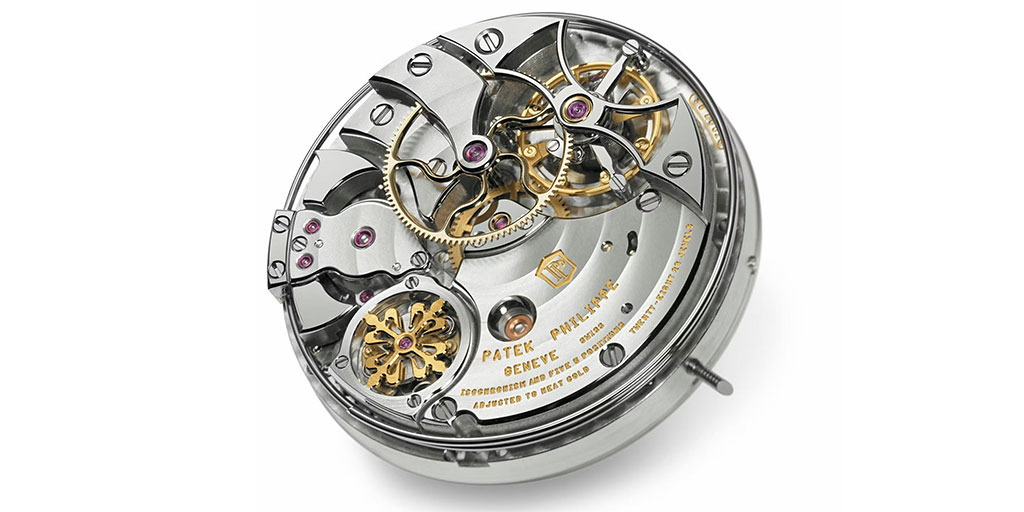
The spectacular caliber R TO 27 PS QR, here with Patek Philippe Seal. Image credit: Patek Philippe
Accessories
The watches were delivered with a pin buckle in the same metal as the case. Upon client request, a folding buckle was delivered instead.
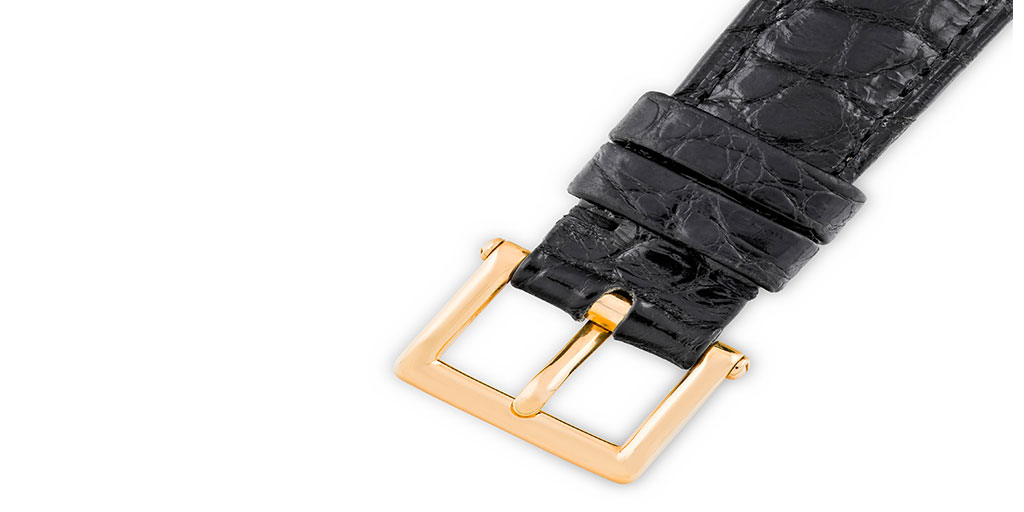
The standard pin buckle which came with ref. 5016. Image credit: Christie’s
A full set of accessories undeniably elevates any ref. 5016, as it serves as a testament to the watch’s history, particularly through the initial rate certificate. The full set comprises the Certificate of Origin, the rate accuracy certificate, an additional solid case-back, a setting pin, a leather portfolio, a photograph, an instruction manual, product literature, a fitted presentation box with its key, and the outer packaging.
Additionally, collectors are always encouraged to request an Extract from the Archives, which will confirm the date of manufacture, date of sale, the dial the watch left the factory with, and any recorded modifications. A watch for which an Extract cannot be obtained, for any reason, generally trades at lower prices.
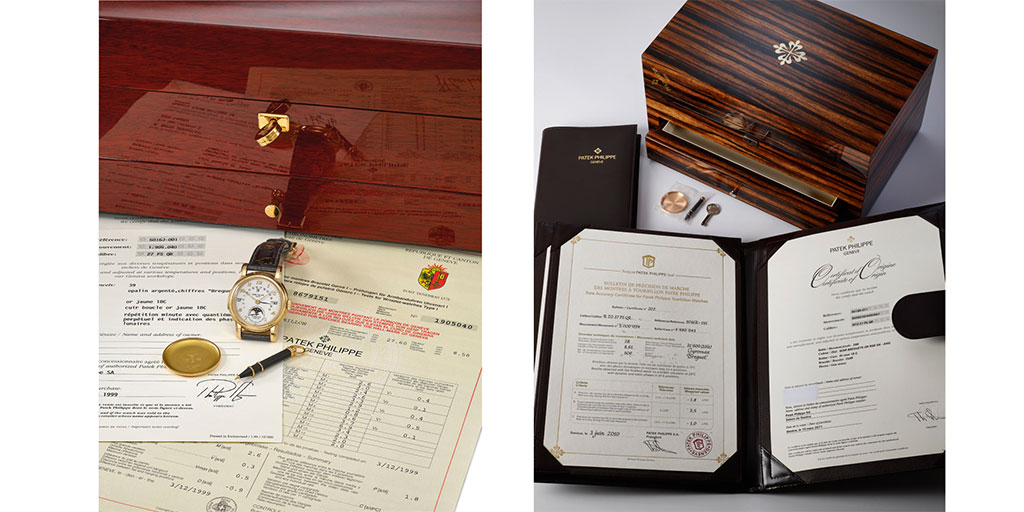
The full set of accessories evolved over the 18-year production period, which can be seen in the different boxes generations.
On the left: Geneva Seal watch with Republic and Canton of Geneva rate certificate. Image credit: Christie’s. On the right: Patek Philippe Seal watch with Patek Philippe rate certificate. Image credit: Christie’s
Defining series
Produced between 1993 and 2011, the ref. 5016 naturally evolved over its 18-year production span with slight incremental changes. Based on my empirical research, four series can be defined, characterized by evolutions of the dial and movement. These series are intended to serve as a guide for collectors, and not officially defined by Patek Philippe.
The movement number ranges, dates, and production figures are approximations, and as always, exceptions exist. Patek Philippe does not publish production figures, and these findings may evolve as new information comes to light.
While the calendar font on first-series and early second-series examples was small, it was enlarged to a larger, more legible size during the second series — a size that was retained until the model was discontinued.
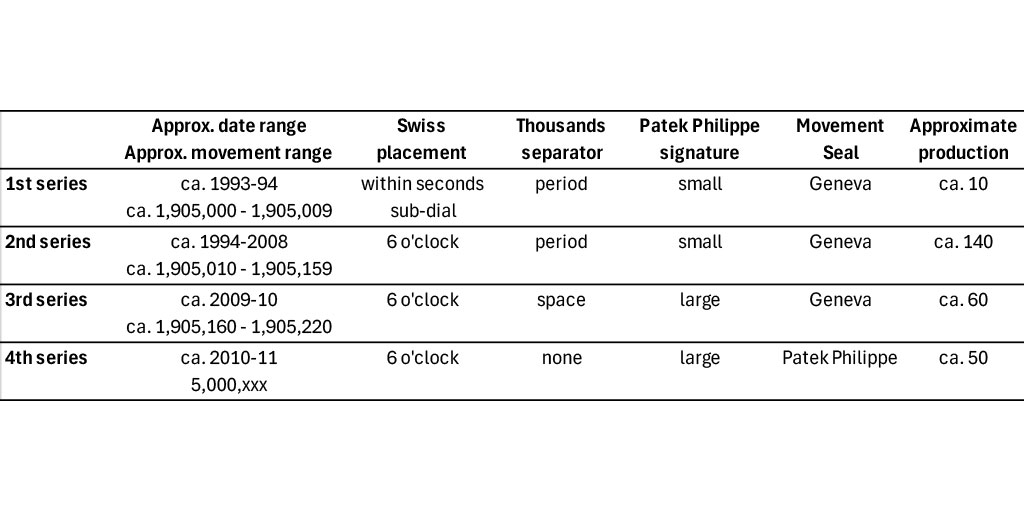
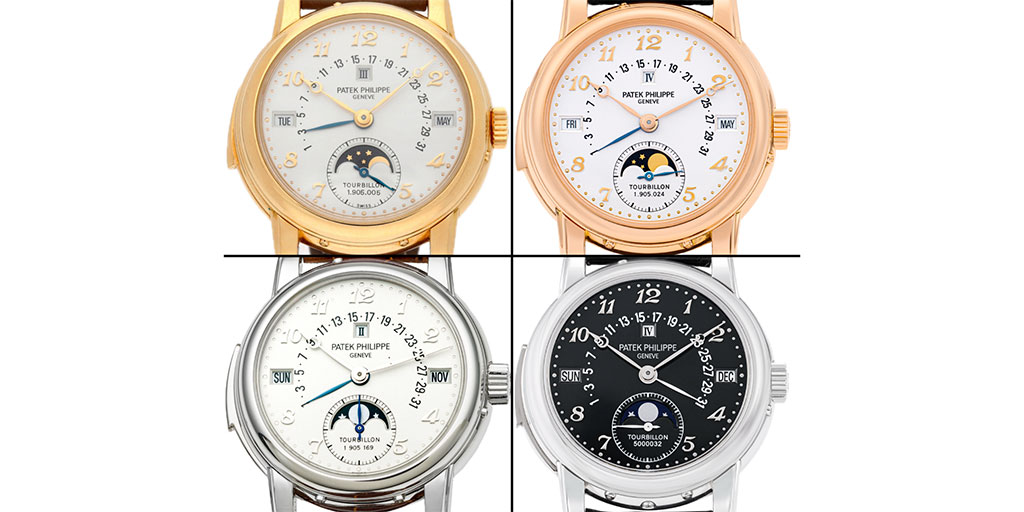
Top left: 1st series, SWISS in small seconds sub-dial. Credit: Sotheby’s. Top right: 2nd series, SWISS at 6, thousands in movement number with dots. Image credit: Christie’s. Bottom left: 3rd series: thousands in movement number with spaces. Image credit: Antiquorum. Bottom right: 4th series: thousands in movement number without spaces. Image credit: Christie’s
Note: the 2nd series illustrated features the early small calendar font. The large font was introduced during the 2nd series, and can be seen on the 3rd and 4th series illustrated above.
Special orders
Given the long production run of ref. 5016 and company policies at the time, quite a few special orders were made over the years. This also reflects the fact that it wasn’t an easy sale, it was not a watch with a waiting list, and clients were not standing in line to put their names down in the hope of receiving one. Patek Philippe would help accommodate special client requests to support sales. Because Patek Philippe has typically not disclosed these special orders, further discoveries are to be expected.
As black dials were offered in the collection — sometimes both a silver and a black dial were delivered with the watch — they will not be discussed here unless further personalizations were made.
As noted earlier, verifying that the movement number printed on the dial matches the engraved movement number is especially critical here — some of these special dials have since been swapped between watches. If the numbers don’t match, the dial did not leave the factory with that watch and should be considered a spare part that does not belong to it.
5016A-010 Only Watch – unique piece in steel
When Patek Philippe unveiled a unique piece to be auctioned for the Only Watch charity in 2015, the watch world knew this was something special. Four years after its discontinuation, Patek Philippe introduced a steel version of the ref. 5016 — the rarest metal for non-sports watches — featuring a blue enamel dial with applied Breguet numerals. Notably, the dial does not feature the movement number at 6, and the calendar apertures are surrounded by small applied gold frames.
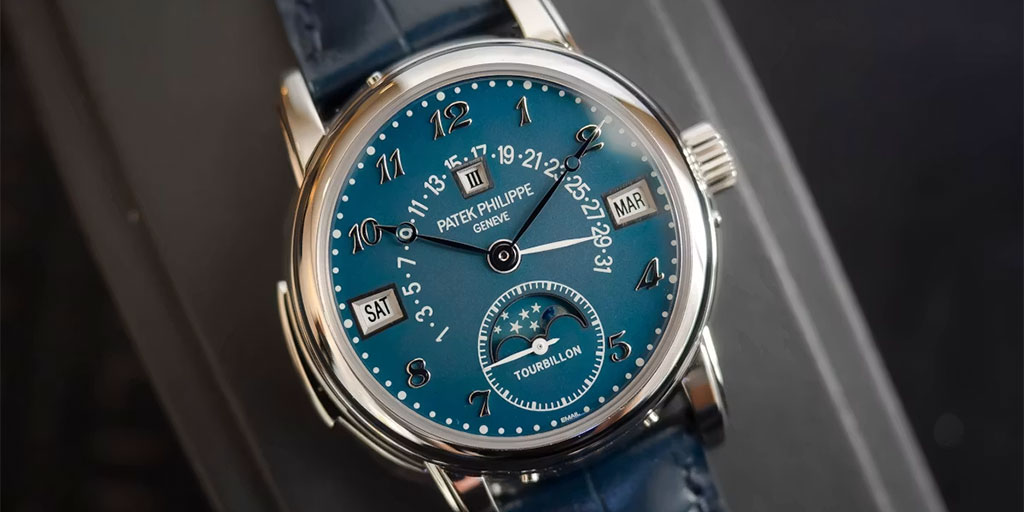
The unique ref. 5016 in steel with blue enamel dial made for the Only Watch charity, which was the most expensive wristwatch in the world at the time of the auction. Image credit: Hodinkee
The result did not disappoint: CHF 7.3M, a world record for the most expensive wristwatch ever sold at the time, and the second most expensive timepiece ever after the Graves Supercomplication, which sold for USD 24M in 2014.
For more about Patek Philippe’s unique pieces offered for charity, John Reardon’s article is highly recommended.
Eric Clapton and Michael Ovitz commissions
Famed musician and watch collector Eric Clapton commissioned two ref. 5016 watches with metal bracelets, both bearing his monogram EPC (Eric Patrick Clapton) on the case-back:
- 5016/1G, black dial. Sold at Christie’s in 2014 for USD 738k
- 5016/1P, silver dial
Michael S. Ovitz, co-founder of the CAA talent agency and briefly President of Disney, commissioned special variants of the ref. 5016 bearing his monogram, MSO, at 6 in lieu of the minute marker. Two watches are known, though they have never been offered for public sale:
- 5016J, brown dial
- 5016G-014, salmon dial
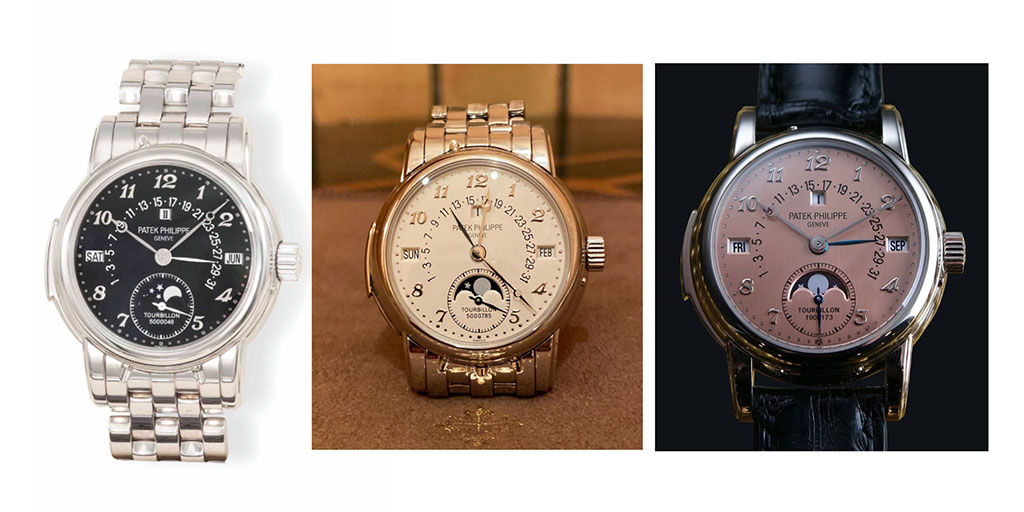
From left to right: Refs. 5016/1G and 5016/1P with metal bracelet commissioned by Eric Clapton. Image credit: Christie’s; @horology_ancienne Ref. 5016G-014 with salmon dial and MSO monogram. Image credit: @only_therarest
Black and red dials
Three watches are known with black dials and contrasting red accents, all with slightly different personalizations:
- 5016G-015, date in red. Sold at Sotheby’s in 2022 for USD 1.3M
- 5016P, outer minute track, retrograde calendar, and day & month in red; Italian calendar. Sold at Antiquorum in 2012 for USD 723k
- 5016P-019, red minute scale, day indication and text. Sold at Christie’s in 2019 for USD 882k

Three special orders with black and red dials. From left to right: Ref. 5016G-015 (Image credit: Sotheby’s); Ref. 5016P (Image credit: Antiquorum); Ref. 5016P-019 (Image credit: Christie’s)
Black Mother-of-pearl dial
It is extremely rare for Patek Philippe to make dials in mother-of-pearl on complicated watches and men’s watches in general, though one special order is known in pink gold with a black mother-of-pearl dial. The watch is a late series with Patek Philippe Seal movement.

Ref. 5016R special order with black mother-of-pearl dial. Image credit: @miketay
Roman numerals dials
A few watches have been made with Roman numerals in lieu of the Breguet numerals:
- 5016P with both a silver and a grey dial with Roman numerals and Dauphine hands. Initially commissioned for a world-renowned Japanese Ferrari collector. Last sold at Antiquorum Hong Kong in 2015 for USD 661k.
- Grey dial with Roman numerals. Sold as a spare part alongside a watch with a non-matching movement number, via Phillips

Ref. 5016 special orders with Roman numerals. Image credits: Phillips, Antiquorum
Gem-set dials
Several watches were made with gems partially or entirely replacing the Breguet numerals:
- 5016J, silver dial, Breguet numeral at 12, rubies for the other indexes. Sold at Christie’s in 2012 for USD 529k
- 5016R, silver dial, Breguet numeral at 12, rubies for the other indexes. Sold at Christie’s in 2013 for USD 572k
- 5016R, black dial, diamond indexes. Sold at Phillips in 2022 for USD 841k
- 5016P, silver dial, ruby at 12, diamonds for the other indexes. Sold at Antiquorum in 2009 for USD 621k
- Black dial, baguette diamond indexes, outer minute track. Sold as a spare part alongside a watch with a non-matching movement number, via Sotheby’s
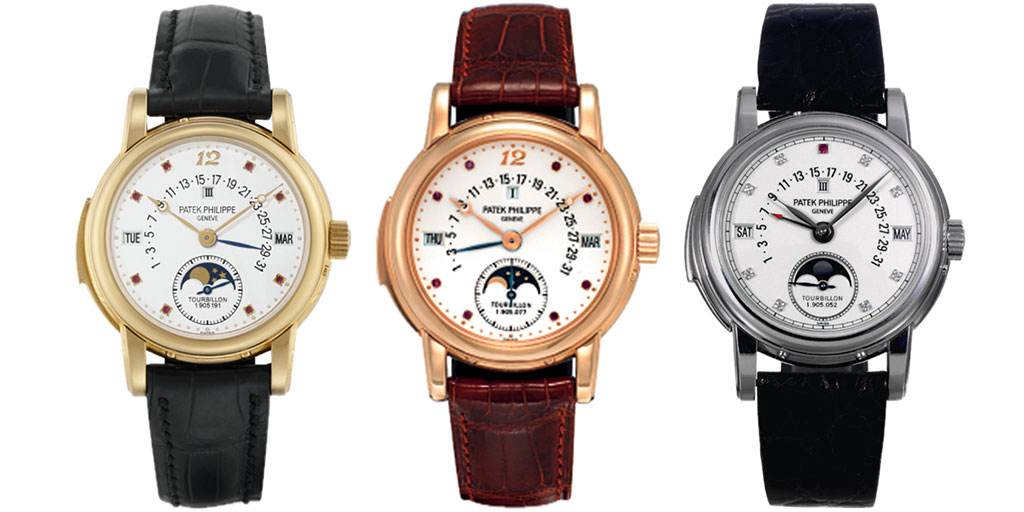
Refs. 5016J and 5016R with Breguet 12 and rubies; 5016P with ruby at 12 and diamonds. Image credits: Christie’s, Antiquorum
Further personalizations
The following watches are known to feature further personalizations, variations on the standard production dials:
- 5016J, grey dial, via Antiquorum
- 5016R, black dial, blue date and small seconds hands, via Sotheby’s
- 5016R, grey dial, sold as a spare part alongside a watch with a non-matching movement number, via Sotheby’s
- 5016P, both a copper and an anthracite dial, via Antiquorum
- 5016P-021, silver dial with pink gold numerals, via Christie’s
- 5016P, black dial, luminous hands, via Christie’s
Collectability and market analysis
Now that we have studied the importance and variations of the ref. 5016, we will look at collectability from a collector’s perspective. The following analysis is based on auction results from Antiquorum, Bonhams, Christie’s, Dr. Crott, Eppli, Monaco Legend Group, Phillips, and Sotheby’s from 2000 to May 2026, converted to USD at the exchange rate on the day of the sale. In this period, ref. 5016 appeared 74 times, representing 64 unique examples after removing duplicate sales.
Production estimates
Despite its 18-year production run from 1993 to 2011, with a handful of later production pieces, ref. 5016 is a very rare piece. The following estimates are based on my research, and as Patek Philippe will not confirm these numbers, these estimates may evolve as new information comes to light.
Based on auction appearances of unique examples, the distribution by metal and dial type is as follows:
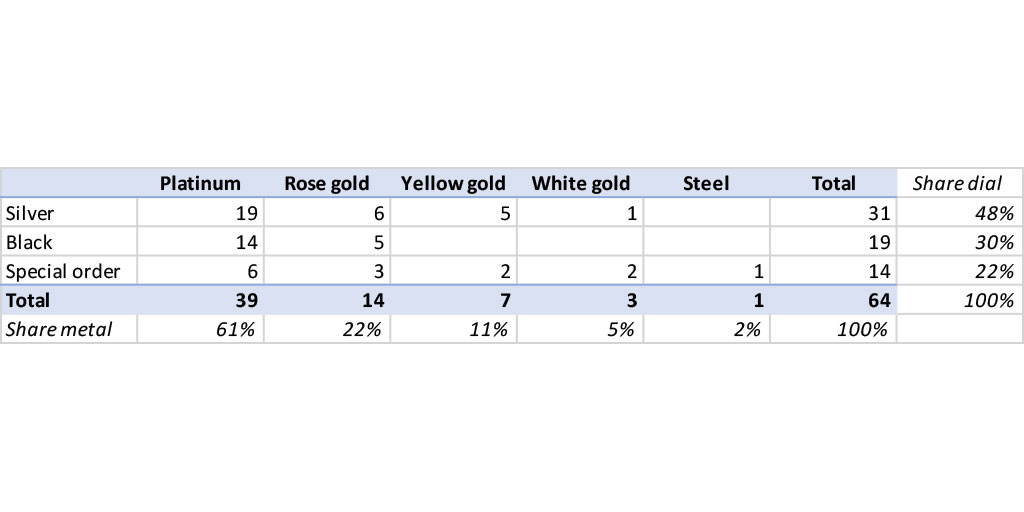
Assuming about 20 to 25% of production has returned to the market at auction, and cross-referencing with known movement numbers for total production, we can extrapolate that approximately 250 to 300 pieces were made, with the following breakdown by metal:
- Platinum: 150-200
- Rose gold: 50-70
- Yellow gold: 30-40
- White gold: 10-20
- Steel: 1
This would imply an average of 13 to 15 pieces per year over the total production span, that is just a little more than one per month, attesting to the complexity of the watch’s production.
A few points are notable:
- Platinum, while generally considered the rarest precious metal, was the most-produced, accounting for approximately 60% of total production
- In regular production, 60% of watches came with a silver dial, while 40% came with a black dial — a significant share
- One in five watches that appeared at auction had a special-order dial, a very high share compared to other references
Interestingly, this production split by metal and dial is not dissimilar to that of ref. 5004 (see dedicated Collector’s Guide), another flagship model from the same era. This certainly attests to the fact that the ref. 5016 was not an easy sale at the time, and that Patek Philippe was willing to accommodate client requests to support its retailers.
Market analysis
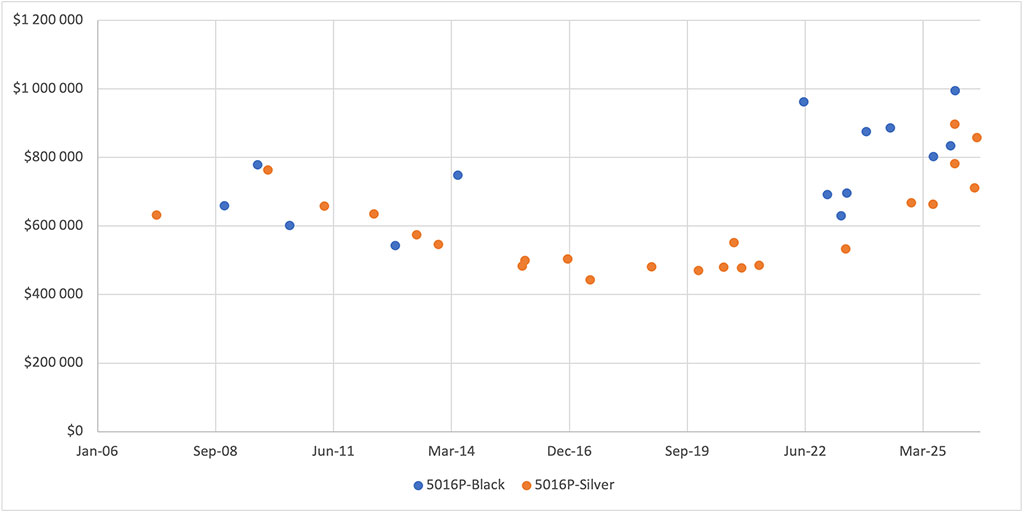
For greater clarity in the market analysis, results have been split by metal and dial type. As special orders appear too infrequently and are generally not comparable, they have been excluded from this analysis.
Platinum:
Gold:
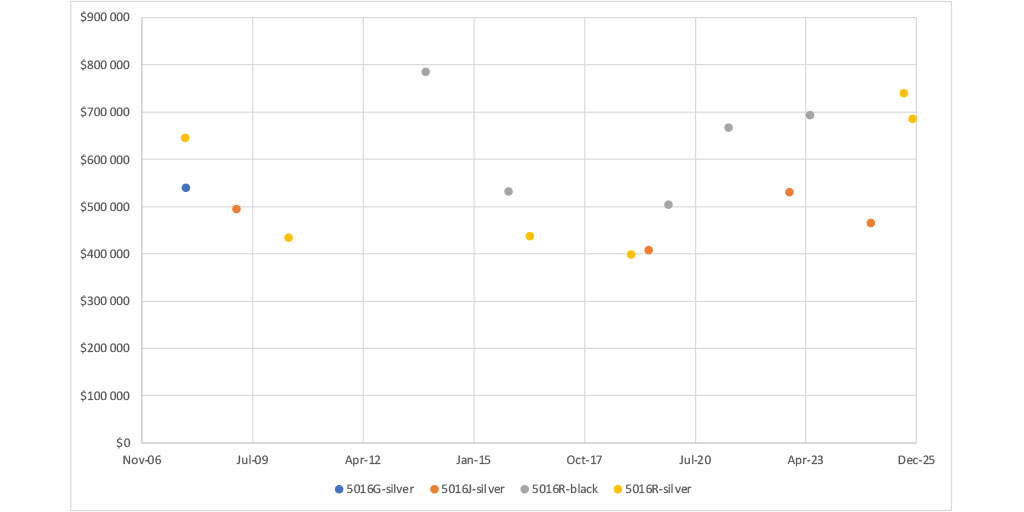
After an initial phase of higher prices around 2008-2012, the market retracted until around 2022, when prices began reaching new heights with renewed interest in neo-vintage watches. The ref. 5016 offers significant value, as it was Patek Philippe’s most complicated watch for almost a decade and played a key role in positioning the brand as the Haute Horlogerie leader following the quartz crisis, while retaining a classical, brand-defining design.
Two elements are notable:
- The market values platinum higher than gold examples, despite platinum being the most-produced metal
- As no formal series for ref. 5016 had been defined, the market does not value any of the series differently
It remains to be seen whether this will change going forward.
That said, collectors are generally advised to prioritize condition over rarity. A watch in excellent condition will always hold a special place in a collection regardless of its series or metal, particularly when it also comes with its full set of accessories, which for ref. 5016 includes an official rate certificate.
Conclusion
The ref. 5016 was succeeded by the ref. 5216 (2011–2016) and subsequently the ref. 5316 (2017–present), both of which build on the 5016’s foundations with the same exceptional caliber R TO 27 PS QR — a testament to the enduring relevance of this movement, which lives on to this day. While the ref. 5216 introduced a case inspired by the traditional Calatrava design, the ref. 5316 can be considered a modern evolution of the ref. 5016.
Extremely significant to Patek Philippe’s history, the ref. 5016 marked the moment the brand reaffirmed its position as the leader in Haute Horlogerie following the quartz crisis, and stood as its most complicated wristwatch for nearly a decade. It remains highly sought after by collectors who recognize its importance, its rarity, and its rare ability to bring together extreme complexity and timeless elegance in a single, beautifully resolved timepiece.
Edouard Henn has been passionate about horology since his teenage years. He began his professional journey in the watch industry in Switzerland before transitioning to luxury retail across Europe and the Middle East. With a business education background, Edouard brings both product and collector’s perspective to his writing. Now based between Geneva and Paris, he enjoys sharing horological knowledge and connecting with fellow enthusiasts in the watch community.