Among the rarest and most extraordinary creations produced by Patek Philippe are the miniature enamel pocket watches made between 1950 and 2000. These pieces are a testament to Patek Philippe’s role as patron of the arts and guardian of disappearing traditional crafts.
At a time when the ancient art of miniature enamel painting faced extinction, the Stern family chose patronage over profit, commissioning works they knew had little commercial market to keep this centuries-old tradition alive. This is how they preserved many pieces in their own Museum for the public to admire. In doing so, they ensured the survival of a craft that might otherwise have been lost to history.
Each of these watches is unique, featuring hand-painted reproductions of masterworks spanning from Dutch Golden Age paintings to French Impressionism. Created by a small group of exceptionally talented artists – most notably Suzanne Rohr, whose career was defined by her work for Patek Philippe – these timepieces required months, sometimes years, to complete.
This guide explores the history of miniature enamel painting, the technical artistry required, the artists who devoted their lives to this craft, the most remarkable examples known today, and a perspective on collectability. With an estimated 200-250 pieces created over five decades and only 133 documented, these watches represent a pivotal chapter in both Patek Philippe’s history and the preservation of traditional handcrafts.
A Brief Historical Perspective
To understand why these pieces matter, we must first trace the centuries-long evolution of the craft that nearly died in the 1950s.
The technique of miniature enamel painting was invented in France around 1620 by Jean Toutin, who developed a range of enamels with colors comparable to oil painting that could be applied with a brush to execute the finest details. From the beginning, it was designed to reproduce images with the greatest precision at a miniature scale. Shortly after, the technique reached Geneva. Pierre I. Huault, a French refugee in Geneva, applied painted enamel to the decoration of watch cases, establishing the close collaboration between watchmakers and enamelers that would define Geneva’s reputation.
The art experienced a renaissance in the second half of the 18th century with innovations like soft enamel and fondant. Geneva emerged as a luxury producer, with “Geneva enamels” becoming synonymous with quality across the world. Between 1820 and 1850, production was particularly rich, characterized by an enriched color palette and the famous black used in champlevé work.
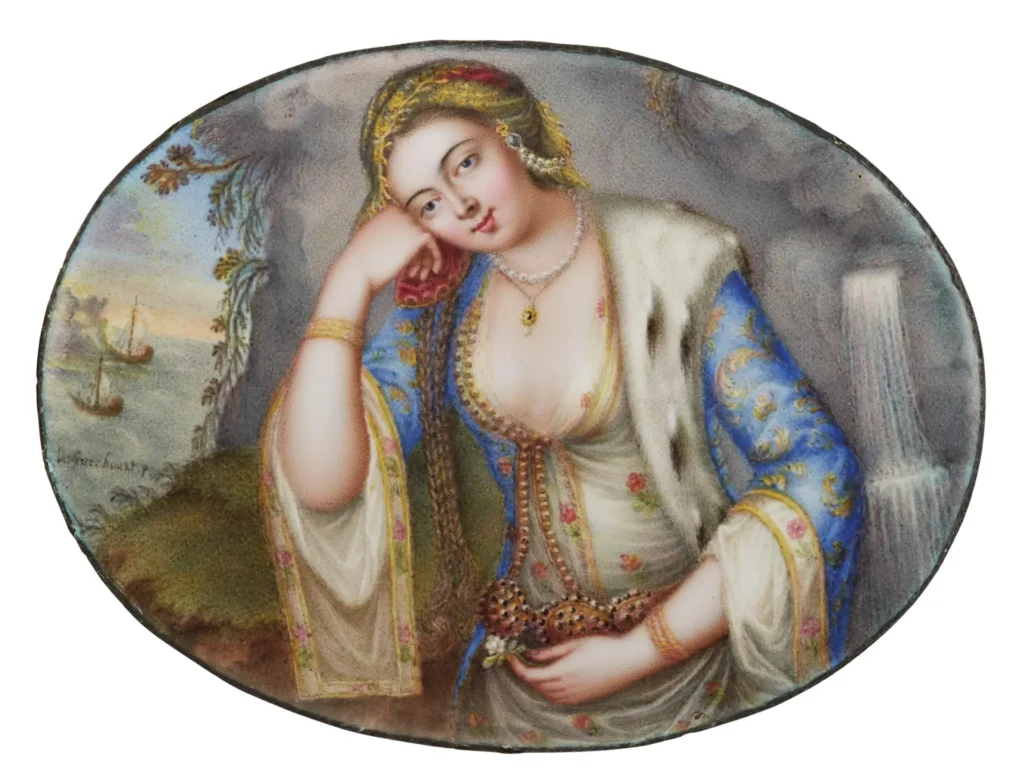
Jeune femme en costume turc, Jean-Pierre & Amy Huaud, ca. 1715. Credit: Patek Philippe Museum
The decline began in the second half of the 19th century. Enamel painters couldn’t adapt to new painting styles like Impressionism, while photography obliterated the market for painted portraits. By the 1950s, enamel painting was reserved only for a few luxury watches, professional teaching ended in the 1970s, and the entire skill was at risk of being lost and forgotten.
This is when Patek Philippe and the Stern family played a pivotal role. From the 1950s onwards, they kept on commissioning miniature enamels from various artists despite knowing that finding clients for the watches would be a great challenge. This is also how they kept dozens of examples for their own Museum. In the same spirit, they commissioned Dome Clocks every year, where artists could practice mostly cloisonné and champlevé, which are more suited to the larger surfaces. They acted as true patrons of the art, and the entire industry owes Patek Philippe a lot for having kept enameling – and to a larger extent rare handcrafts – alive.
The Art of Enamel Miniature Painting
Enamel has been used for millennia, long before the invention of watches, to embellish tableware, religious objects, and jewelry. Put simply, enamel is powdered glass applied in layers onto a metal base before being fired in a kiln. The techniques evolved and were refined over time, with several distinct methods emerging, including champlevé (where enamel fills engraved cavities in the metal); cloisonné (where thin gold wires create compartments that contain different enamel colors); and miniature painting (where the artist paints directly onto an enamel surface). Grand Feu miniature painted enameling is the art’s highest form and the focus of this article.
Before even starting to paint, the artist has to create their own color palette. The colors are made of various metallic oxides, which are ground into powder and then mixed with an oil-based binder. Sourcing these metallic oxides is a great challenge in and of itself, as specialized firms closed from the 1950s onwards following a lack of demand. For miniature painting, the oxides have to be particularly finely ground to allow for minute brush strokes. These colors are then applied to a sample dial or case and baked at temperatures exceeding 1,500°F (800°C) so that the artist can visualize the final color.
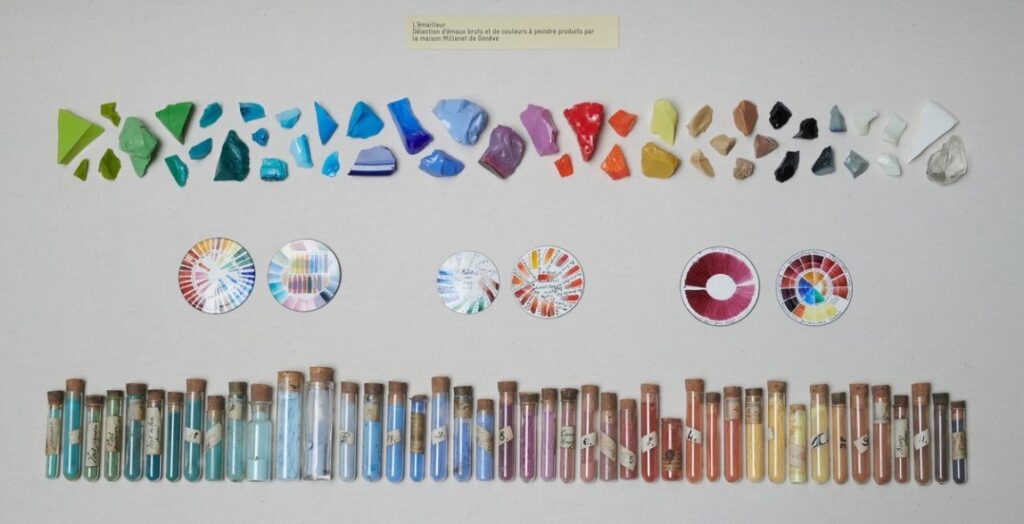
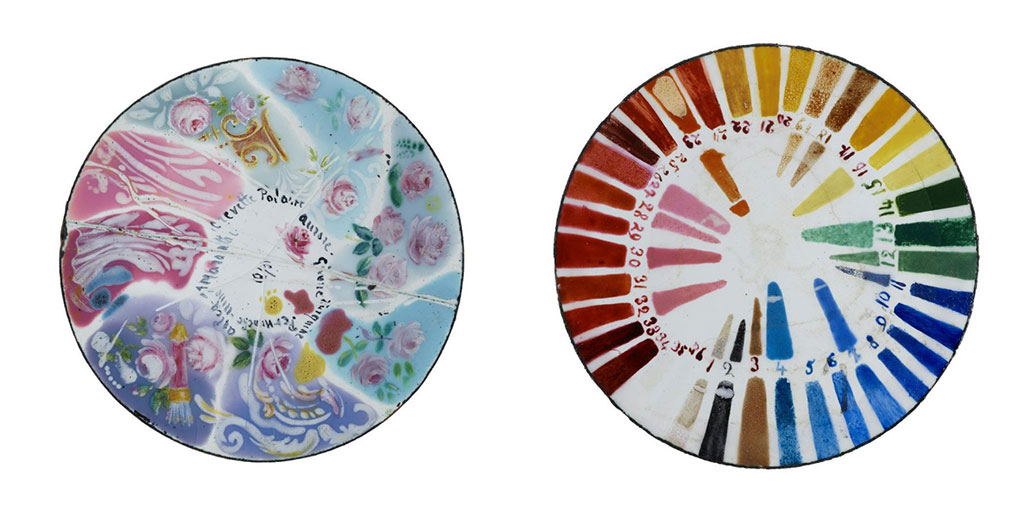
Rough and powdered enamels; enamel sample paintings to assess the final colors from Hélène May Mercier’s collection. Credit: Musée d’Art et d’Histoire, Geneva (MAH)
Miniature enamel painters traditionally copied their subjects from engravings or paintings rather than working from life, which would be impractical given the lengthy process. Once selected, the enamel artist first shrinks the original image and reproduces it in a round, smaller size, a so-called “tondo”, which will in turn become the basis for the reproduction on the watch. This is not simply a copy but sometimes requires reinterpretation to fit the narrow dimensions while staying true to the original – hence the need for critical artistic skills.
The artist starts with a thin sheet of gold (or brass for dials). A layer of white enamel is applied to this metal base, creating the surface for painting. These previously prepared enamel colors are then applied with a brush – sometimes made of only a single sable hair – allowing for extremely fine details. The piece undergoes successive firings in a kiln to set each phase of the painting, building up the image gradually. Once finalized – a process that usually takes several months, sometimes years – a final layer of protective transparent fondant is applied, giving its final touch and characteristic glossy appearance.
Beyond the precision and skills required, the main limitation is that once a piece has been fired, it cannot be retouched. Any mistakes cannot be corrected. Each firing also risks cracking the dial, which would result in an irreparable defect possibly destroying months of work. The entire process requires not only great artistic talent to understand a painting but also an incredible precision, patience, calm, and perseverance. Rarely can an artist work more than a few hours a day on a project, as the concentration required is immense.
The Miniature Enamel Artists
The technical mastery required explains why only a handful of artists could meet Patek Philippe’s standards and how they contributed to creating these pieces. The artists we will explore are ranked by the number of known pieces made.
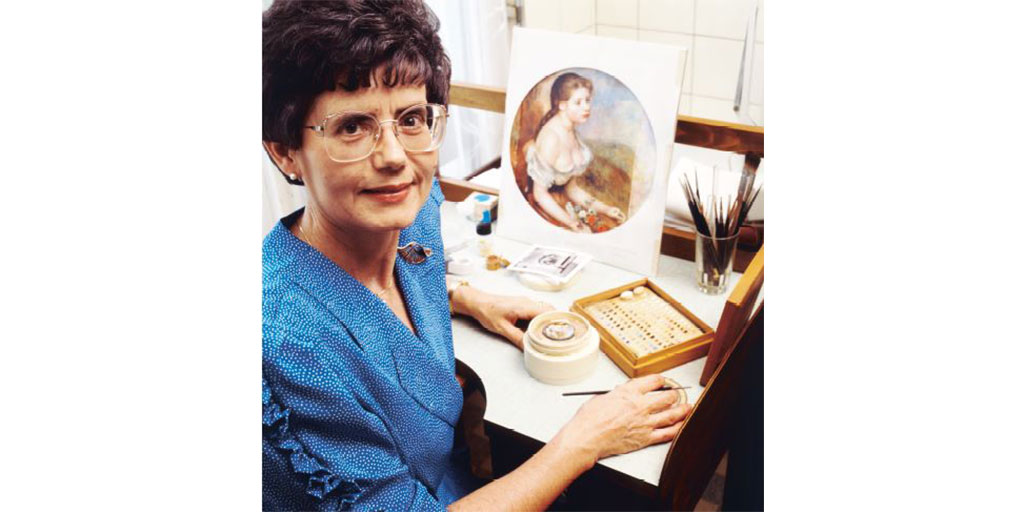
Suzanne Rohr working on “A Young Girl with Daisies” after Auguste Renoir in her atelier, circa 1992. Note the work reproduced on the round “tondo”, which serves as a reference for painting the watch. Image credits: Suzanne Rohr: Patek Philippe
Suzanne Rohr – 1960s-2000s, 64 known pieces, 1960s-2000s
The first name that comes to mind and certainly the most celebrated miniature enamel artist of her generation is Suzanne Rohr, known for her exceptional skills and the emotions she captures in each of her paintings. Born in 1929 in Geneva, Suzanne Rohr grew up in a family immersed in the classical arts. Gifted for painting from a young age, she discovered the art of enameling at an exhibition at the Museum of Art and History in Geneva. She then trained as an enameler and miniature painter at the School of Decorative Arts of Geneva in the class of Elisabeth Juillerat, where she obtained her Federal Diploma in 1959. That same year, she was also awarded the Hans Wilsdorf Foundation prize for creating a lady’s bracelet watch. When she graduated in 1959, Suzanne Rohr was the only student in her enameling class. The art was dying in real-time.
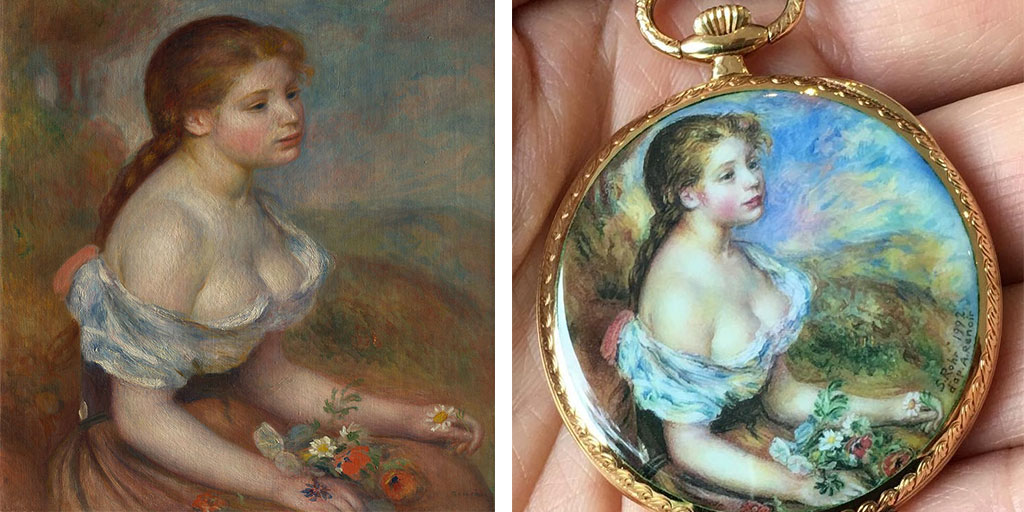
Original artwork, Metropolitan Museum of Art; Pocket watch: @watcharts
It was in the 1960s that she met Genevan miniaturist Carlo Poluzzi, recognized as the greatest enamelist of all time, who became her mentor until his passing in 1978. At his side, she refined her technique and devoted her art exclusively to miniature painting on enamel. He was the one who introduced Suzanne Rohr to Henri Stern, the then-President of Patek Philippe and a great admirer and collector of the arts. She would work exclusively for Patek Philippe from about 1967 until about 2004, when she retired.

Suzanne Rohr (left) with her teacher Elisabeth Juillerat (right). Image credit: WatchProSite
Thanks to Patek Philippe, she could count on regular commissions and constant support from the Stern family. They ordered pieces even at a time when no clients would be interested, and they also supplied the right gold material and enamel powders, which were becoming increasingly rare to find.
In 2017, Suzanne Rohr was awarded the Special Jury Prize at the Grand Prix d’Horlogerie de Genève alongside her former student Anita Porchet and received the Gaïa Prize in 2019 for her pioneering role and mastery of the art of enameling, her perseverance, and her work to train others in these skills.
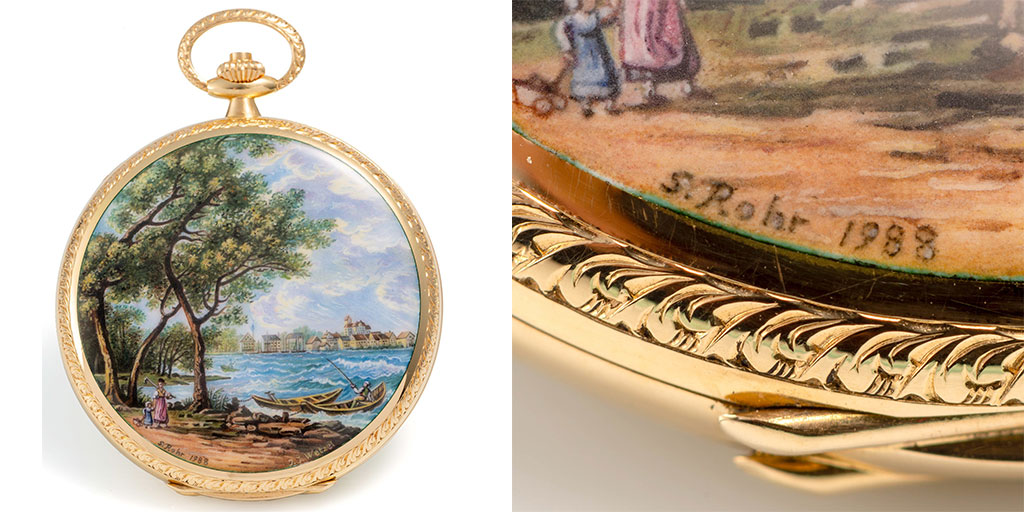
Ref. 865/95 “Romanshorn” after Johann-Jacob Wetzel by Suzanne Rohr. Painted in 1988, sold in 1991. Image credit: Antiquorum
Over her forty-year career, Suzanne Rohr would make between one and three enamel pieces a year, totaling approximately 100-120 creations, of which 25 are in the Patek Philippe Museum, many of the pieces having never been offered for sale. It is said that Mr. Philippe Stern felt such an admiration for the pieces that he would rather keep them for the public to admire than see them in private collections. Notably, some private collectors have also placed their pieces on loan at the Museum alongside Patek Philippe’s collection.
Suzanne Rohr signed her paintings with both her name “S. Rohr” and generally the year of completion and the name of the artist, whose work her creation was based on, generally with “d’après” (“after” in French).
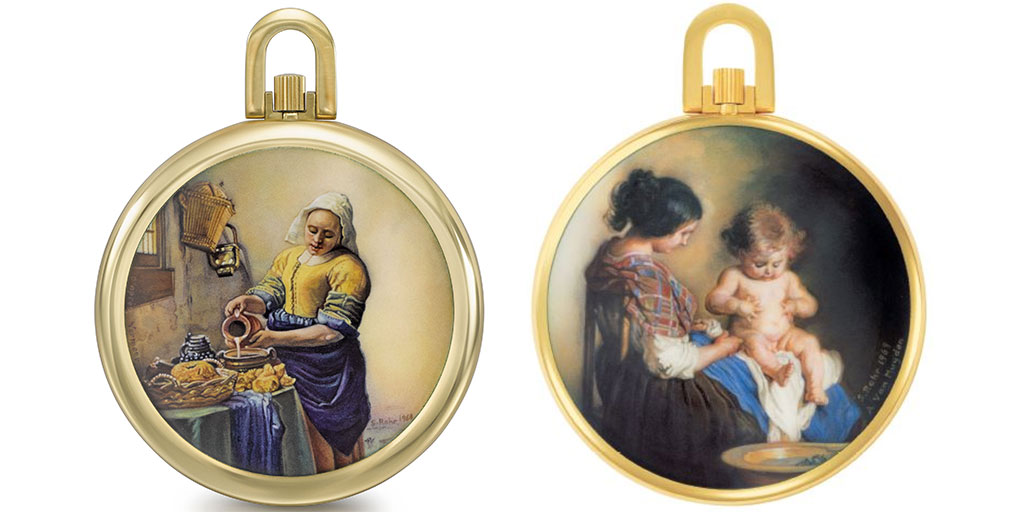
Ref. 715/20 “Mother and Child” after Jacques Alfred van Muyden Painted 1968-70 Credit: Patek Philippe Museum
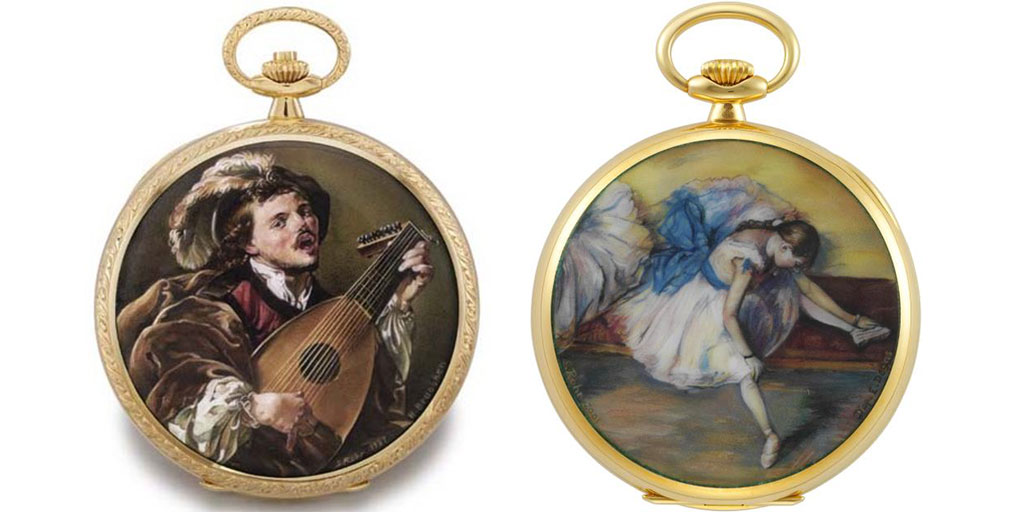
She admirably painted works from an exceptionally large variety of art movements: Dutch Golden Age (Vermeer, van Ruisdael, Cuyp…), Baroque & Rococo (Boucher, Fragonard…), Neoclassicism & Romanticism (Vernet, Géricault…), 19th Century Landscape & Realism (Corot, Boudin, Courbet…), Impressionism & Post-Impressionism (Renoir, Degas). Notably, Swiss artists are particularly well represented (Calame, Diday, de la Rive, Anker…).

Left: Ref. 866/87 “Chevaux s’amusant dans l’eau” after Walter Robin Jennings Painted 1978 Credit: Antiquorum. Right: Ref. 865/62 “Sylvia cures Phyllis of a bee sting” after François Boucher Painted 1983 Credit: Christie’s
The themes depicted are as diverse as the art movements: landscapes, portraits, marine scenes, hunting, animals, maternity… This shows her immense talent and skill, adapting and reinventing her style each time and demonstrating her sensitivity and humanity – a remarkable achievement.
As Carlo Poluzzi was her mentor during her youth, she in turn mentored her protégé Anita Porchet beginning in the 1980s, who was introduced to her by Elisabeth Juillerat. Anita Porchet is now largely recognized as the most important contemporary enamel artist, who masters not only miniature painting but also all other enamel techniques, often combining them with remarkable fluidity.
Giancarlo Menni – 1980s-90s, 26 known pieces, 1980s-90s
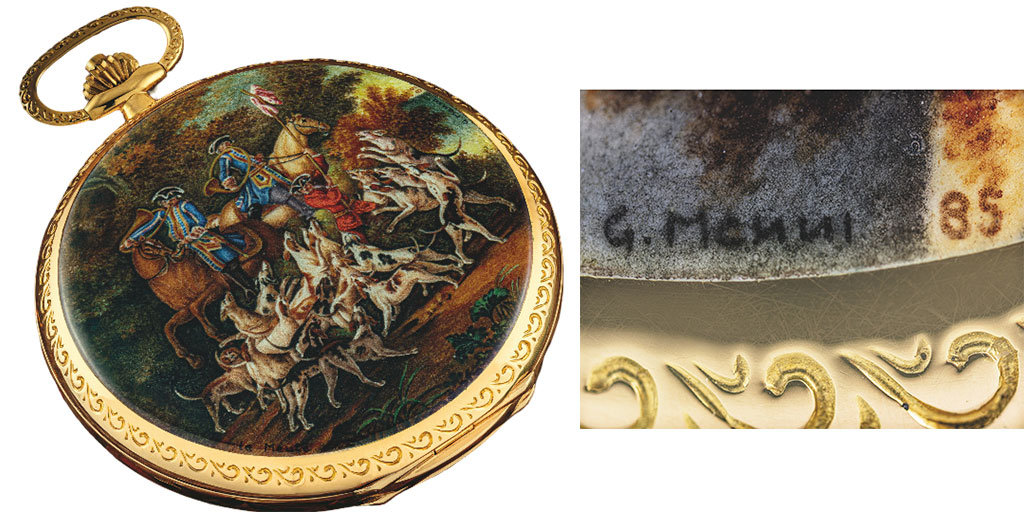
Ref. 865/79 “La Meute” by Giancarlo Menni and signature detail. Painted in 1985, sold in 1990. Image credit: Christie’s
The artist who created the second greatest number of painted enamel pocket watches for Patek Philippe is Giancarlo Menni. While little is known about him, he probably created around 50 timepieces. Of these, 26 are documented, spanning from the early 1980s to the mid-1990s. Like Suzanne Rohr, he generally double signed the works he created with both his name and the name of the artist whose work was represented. His signature reads “G. MENNI” with the characteristic inverted double N.

Ref. 866/109 “View of the Port of Amsterdam” after Jacobus Storck. Painted in 1982, sold in 1994. Image credit: Phillips
Giancarlo Menni also painted from a wide variety of art movements and themes, showing his remarkable talent and adaptability: Old Masters (van Wittel, Storck, Beeldemaker…), Romanticism through Realism (Agasse, Gros, Koller…), Impressionism & Post-Impressionism (Renoir, Segantini), Modernism (Picasso).
Additionally, some of his paintings were original creations, including the ‘Sajou et Sarigue Souris’ piece, made for Daniel Young, and the specially commissioned portraits of a young lady and a young gentleman (see Remarkable Pieces section).
Juliette Pellarin-Leroy – 1960s-70s, 16 known pieces
Juliette Pellarin-Leroy was born in 1898 and passed away in 1984. Though little is known about her, the first known piece she made for Patek Philippe dates back to 1950 and depicts a flower bouquet. She then worked for Patek Philippe mostly in the 1960s and 1970s. Sixteen pieces featuring her miniature paintings are known, of which three are in the Patek Philippe Museum.
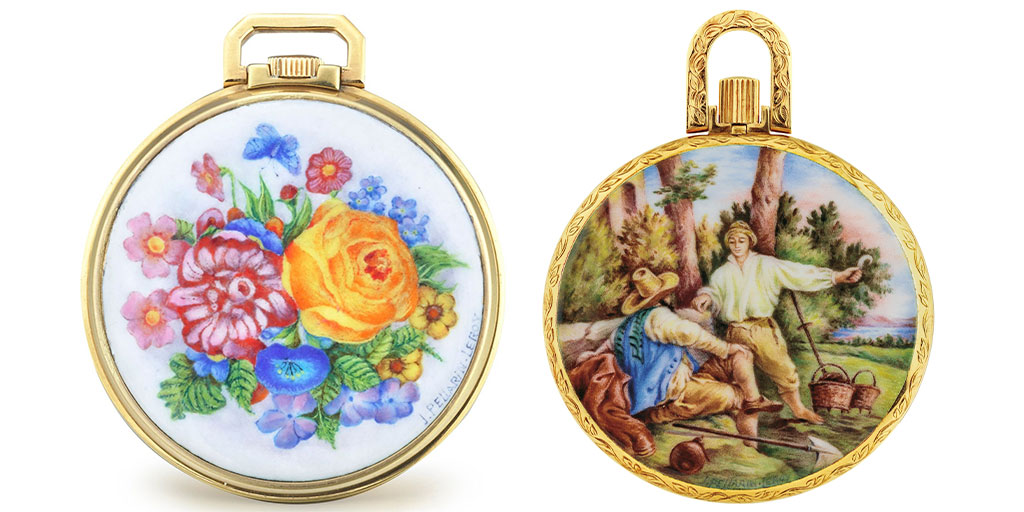
Her paintings are signed J. Pellarin-Leroy, JP-Leroy, or sometimes just JPL. When reproducing an existing painting, the name of the original artist is not mentioned on the dial. The flower bouquets are likely her own creations. Other notable pieces are her portraits and landscapes, which reflect emotions in a way that transcends the technical aspects of painting.
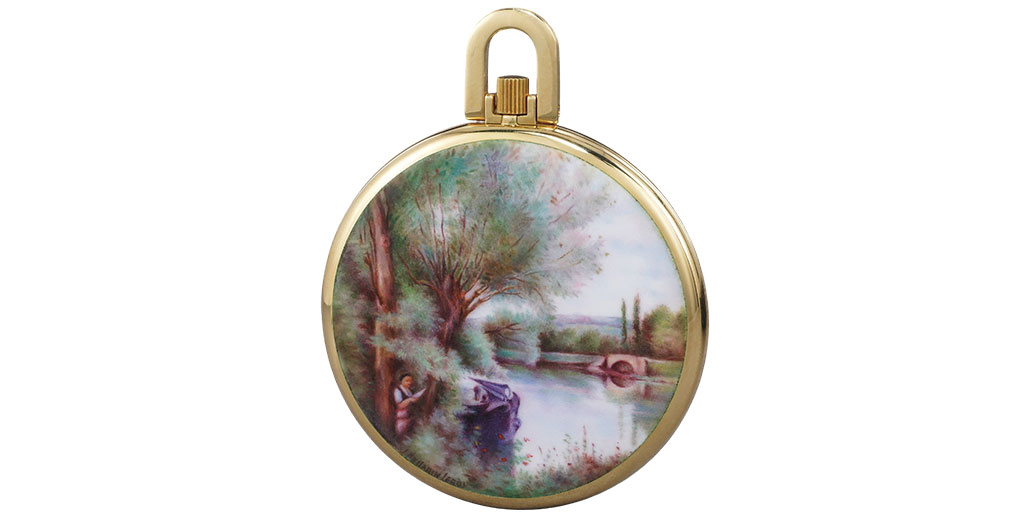
Ref. 715/23 “La Liseuse sur la Rive Boisée” after J-B Corot Made 1970, sold 1982 Credit: Phillips
Marthe Bischoff – 1960s-70s, 11 known pieces
Marthe Bischoff (1900-1991), one of the finest miniature enamelers of the past century, produced remarkable pocket watches for Patek Philippe between the late 1960s and the late 1970s. Eleven of her timepieces are known to exist today. Two of her masterpieces, “The Hunt” (1971) and “The First Consul Crossing the Alps at Great Saint Bernard Pass” (1970), are on permanent display at the Patek Philippe Museum and were never offered for sale.
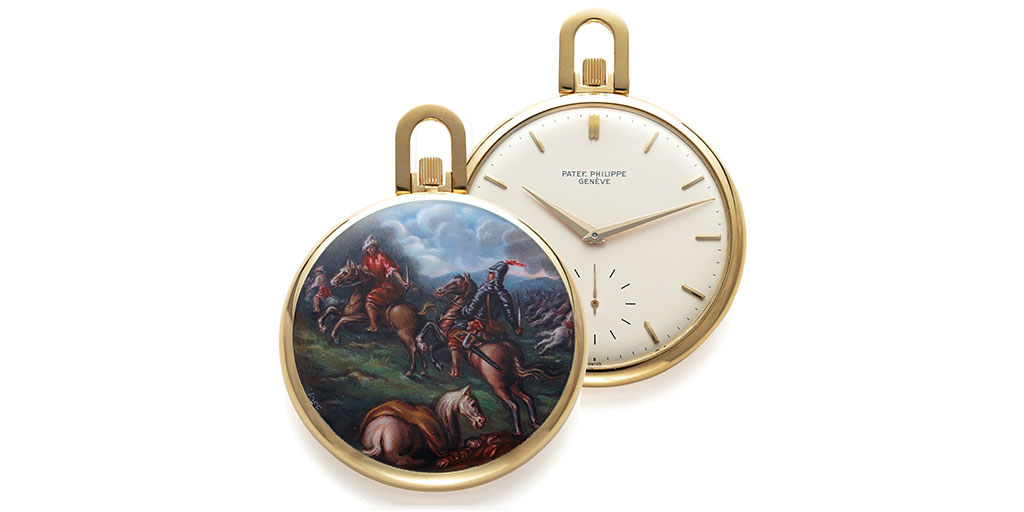
Ref. 866/12 “Guerre des Souabes” Made 1971, sold 1972 Credit: Antiquorum
Marthe Bischoff’s miniature paintings were reproductions of a wide range of styles, mostly old masters, with landscapes, portraits and animal themes. A notable example is Ref. 866/12 “Guerre des Souabes“ (Swabian War), depicting the Swiss Confederacy victory over the Habsburg Empire in 1499, which effectively secured Switzerland’s independence and remains a key moment in Swiss history.
Hélène May Mercier – 1970s, 5 known pieces
Hélène May Mercier (1910-1996) was active as an enamelist for Patek Philippe in the 1970s and was known for the precision of her work. She graduated from the Geneva Ecole des Arts Décoratifs and subsequently taught enamel classes there between 1944 and 1955.
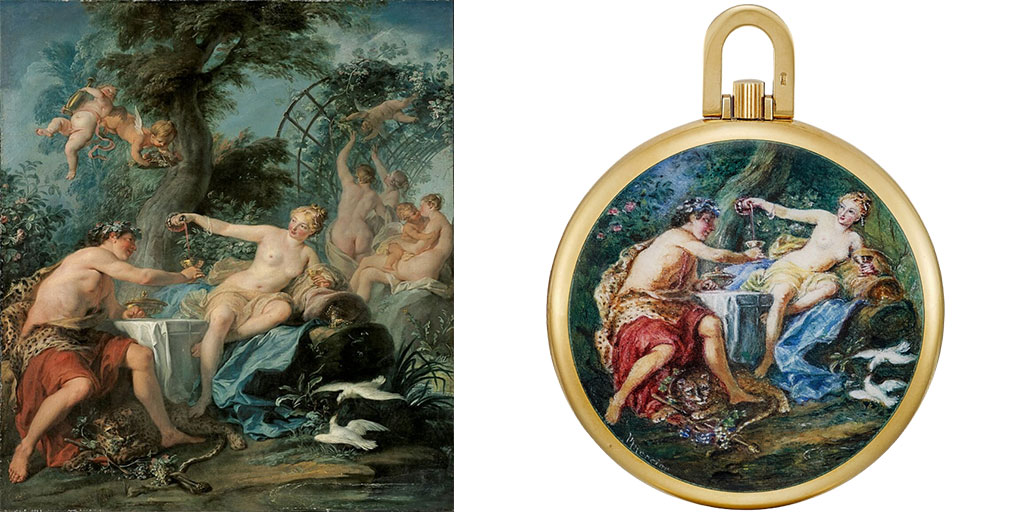
Ref. 866/73 “Bacchus and Venus” after Noël-Nicolas Coypel. Made 1976, sold 1978. Credit: Sotheby’s
Notably, the artist left behind a workshop collection and well-documented archives, preserved at the Museum of Art and History of Geneva, including her collection of dozens of crystals and small pots of enamel powder from the Millenet factory, which remain a reference point to this day.
Five works are known today, depicting various scenes from mythology, portraits, historical maritime scenes, and rural life. “The departure of the Mayflower” after Bernard Finnegan Gribble and “Frederic III, Prince Elector of Brandenburg” after Jean-Pierre and Ami Huand, permanently reside in the Patek Philippe Museum, with the latter never having been offered for sale.
Jean-Luc Péter – 1990s-2000s, 3 known pieces
Jean-Luc Péter is a contemporary independent enamel painter based in Le Locle, Switzerland. He worked for Patek Philippe in the 1990s and 2000s and painted both pocket watches and dome clocks. Working for various brands, he was featured in the 2023 short movie, Painting a dial, produced by the city of La Chaux-de-Fonds, where he can be seen painting in his workshop.
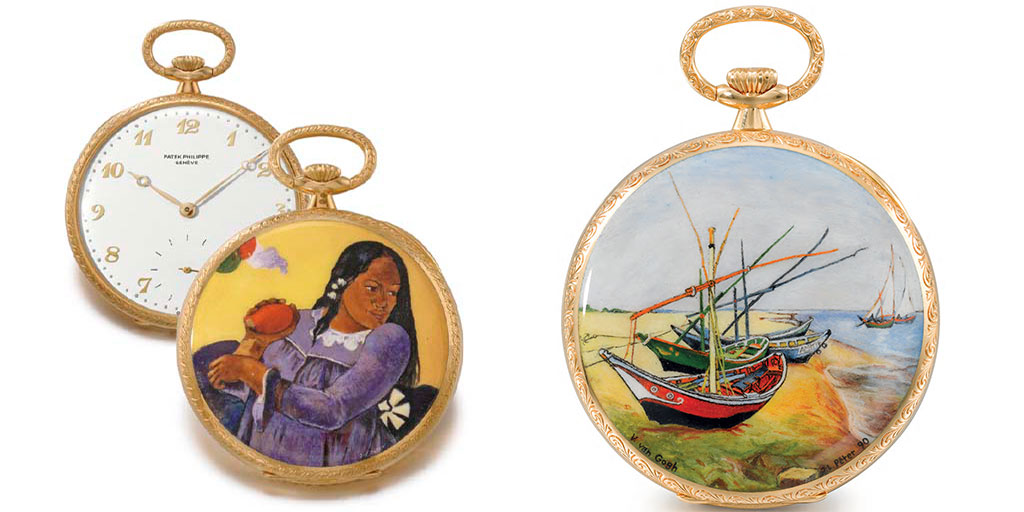
Left: Ref. 652/048 “Woman with a Mango” after Gaugin, Painted 1991, sold 2003. Image credit: Christie’s. Right: Ref. 652/276 “Fishing Boats on the Beach” after van Gogh. Painted 1990, sold 2005. Image credit: Christie’s
Three pocket watches are known to date. Two feature reproductions of post-impressionist paintings: “Woman with a Mango” after Gauguin and “Fishing Boats” after van Gogh. The third, “Commercial Ship”, was a special commission for a shipping company owner and depicts one of his vessels.
Nelly Richard, Luce Chappaz, Muriel Ducrey – 1970s, respectively 2, 2 and 1 pieces known
Nelly Richard (1910-1998) mostly worked on champlevé and cloisonné pieces for Stern Frères, with some of her dials commissioned by Rolex (ref. 6085 “Dragon”, ref. 8382 “Neptune”) as well as Patek Philippe, notably on the worldtimers ref. 1415 and the ref. 2523. Working directly with Patek Philippe, she made several dome clocks, which are recognizable by her “NR” signature. Only two painted enamel pocket watches are known, both made in the early 1970s: “The Triumph of Neptune” after Poussin, remarkable for both front and back covers are painted, as well as “The Water Seller of Seville” after Velázquez – both watches are part of the Patek Philippe Museum collection and have never been offered for sale.
Luce Chappaz (born 1932) is another celebrated Genevan enameler. She received the Prix de la ville de Genève for enameling in 1983. She is most famous for the skillfully made Patek Philippe Dome Clocks, primarily with cloisonné technique, which she signs as “L. Chappaz” or “LChappaz”. Only two pocket watches are known, both made in the mid-1970s and both part of the Patek Philippe Museum collection: “Old Bridge over the Vièze” and “The Mouth of the River Hermance” – neither watch has been offered for sale.
While Muriel Ducrey received a Certificat fédéral de capacité from the Ecole des Beaux Arts de Genève in 1973, little is known about her work. A single pocket watch made for Patek Philippe in 1980 has been identified: “Lake Geneva and Mont Blanc from Bellevue”.
Remarkable Examples – Grandes Complications
Watches combining haute horlogerie and artistry can obviously be considered holy grails, even more so when minute repeaters are combined with further complications and miniature enamel painting.
Unique reference “Poluzzi – Rohr”
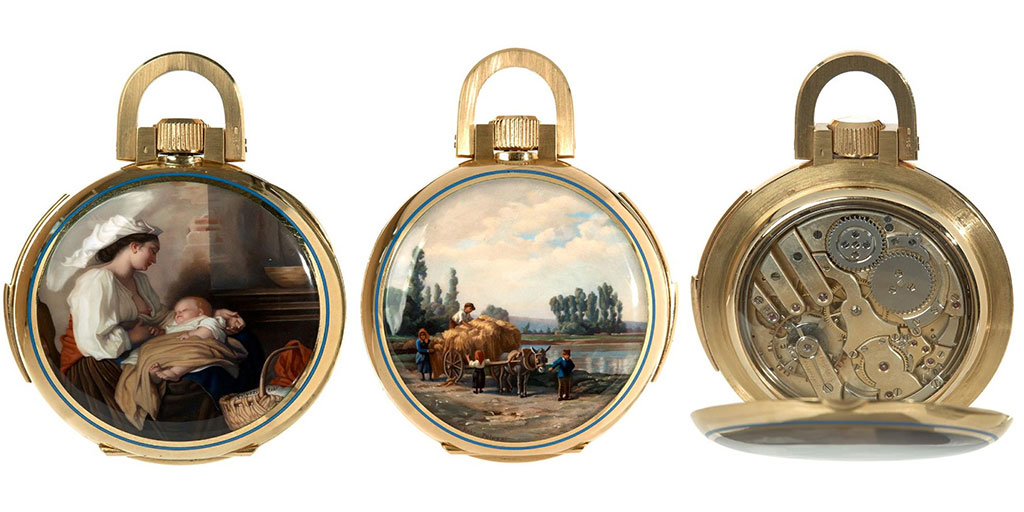
“Mother and child” after Alfred van Muyden and a representation of children harvesting on the other. Movement made in 1966. Image credit: Musée International de l’horlogerie
This piece, made in tandem by the two greatest masters of their generations, encapsulates the spirit of transmission in the art of miniature enamel painting. Each side of the watch is painted: “Mother and Child” after Alfred van Muyden on one side, and a representation of children harvesting on the other. The particularity is that the paintings are signed “Poluzzi – Rohr” and “Rohr – Poluzzi”, respectively. Carlo Poluzzi was in his late 60s to early 70s when the piece was completed, while Suzanne Rohr was in her late 20s to early 30s, and in a true mentor-mentee relationship, one can imagine he passed on the secrets and techniques learned over decades to the next generation. Technically, the watch is no less spectacular: its 1966-made movement features a minute repeater and a perpetual calendar, one of the highest possible combinations of complications in watchmaking. The watch was acquired by the Musée International de l’Horlogerie (MIH) in La Chaux-de-Fonds in 2021, where it remains one of the highlights of the exhibition.
Ref. 864 “The Mosque”

Ref. 864 “The Mosque”, painted by Suzanne Rohr in 1974. Image credit: Christie’s
Combining a minute repeater, perpetual calendar, and a monopusher split-seconds chronograph, this pocket watch features one of the most demanding movements made by Patek Philippe. Certainly commissioned by an Omani dignitary, the watch features a painting of a mosque with a green dome, said to be the mosque adjacent to the College at Wattayah, Sultanate of Oman. While the movement was made in 1964, the enamel painting was made by Suzanne Rohr in 1974. It last sold publicly at Christie’s in 2012 for $805,000.
Ref. 935 “Young Lady and Young Gentleman”
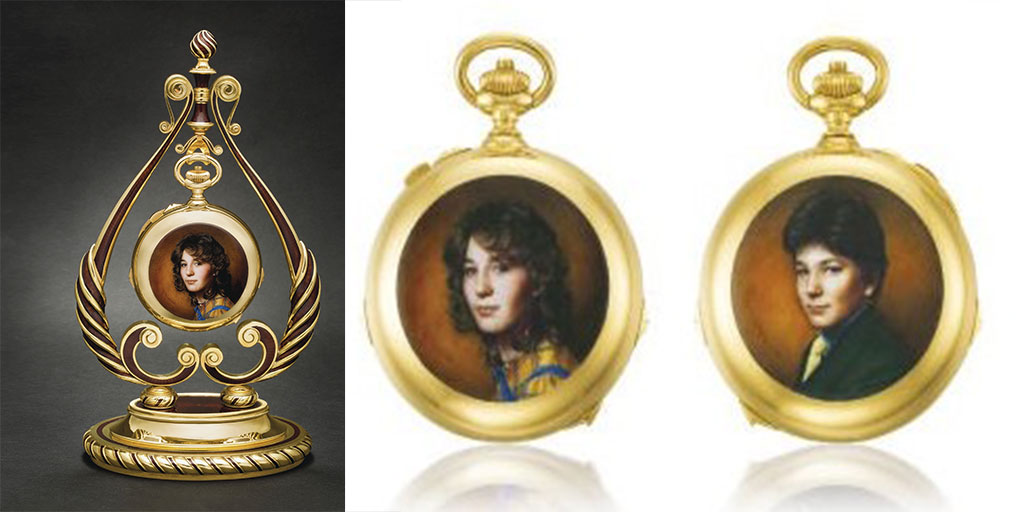
Ref. 935 Young Lady and Young Gentleman painted by G. Menni and completed in 1984. Image credit: Christie’s & Sotheby’s
Specially commissioned, this very personal grand complication was completed in 1984 and features the portraits of a young lady and a young gentleman, probably family members, on either side of the case. Both portraits are signed G. Menni and were skillfully painted with great attention to detail. The watch features a minute repeater with grande and petite sonnerie, a perpetual calendar, and a split-seconds chronograph. The spectacular accompanying stand was designed to display the timepiece. It last sold at Sotheby’s in 2014 for $670,000.
Remarkable Examples – Double-sided pieces
Timepieces featuring miniature paintings on both sides of hunter cases are remarkably rare. Beyond the two previously mentioned grand complications, only six other watches are known in this configuration. Any of these pieces would obviously take twice as long to make, as the same artist worked on both sides to achieve perfect harmony.
The Patek Philippe Museum owns two: “The Triumph of Neptune” after Nicolas Poussin, made by Nelly Richard in 1972, and “Cage and Flower Bouquet” after François Boucher, made by Suzanne Rohr in 1980-81. The latter stands out as it is made for the ref. 885, which has a diameter of only 33mm and requires a further level of miniaturization. Neither watch has been offered for sale.
Reference 823/3 “Chasse près de Fontainebleau” and “Le Débucher” after Antoine Charles Horace Vernet was painted by Marthe Bischoff. While the first painting was completed in 1970, the second was completed in 1975, and the watch finally sold in 1976. Notably, Marthe Bischoff had painted “Le Débucher” twice in 1970, the other example being ref. 714/14, held by the Patek Philippe Museum. The watch was sold by Sotheby’s in 2021 for $724,000.
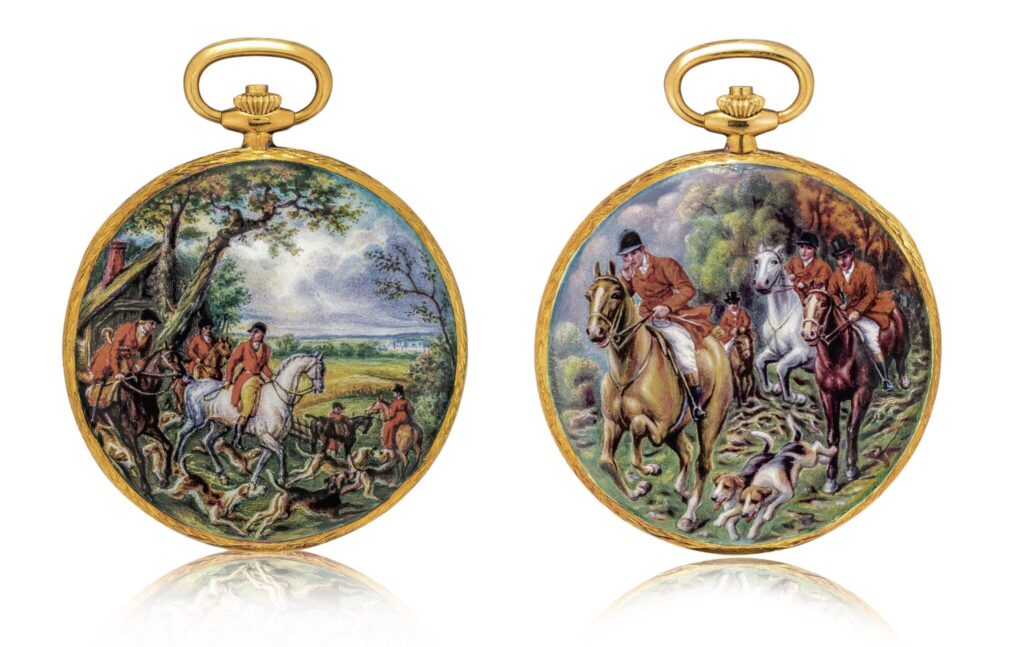
Ref. 823/3 “Chasse près de Fontainebleau” and “Le Débucher” after Vernet painted by Marthe Bischoff. Image credit: Sotheby’s
Giancarlo Menni painted two remarkable views of Venice, Italy, after Dutch painter Caspar van Wittel (also known as Vanvitelli) for reference 865/115. The watch was sold in 1995. It appeared at Christie’s in 2002 and sold for $56,000. One can only wonder how much it would bring today.
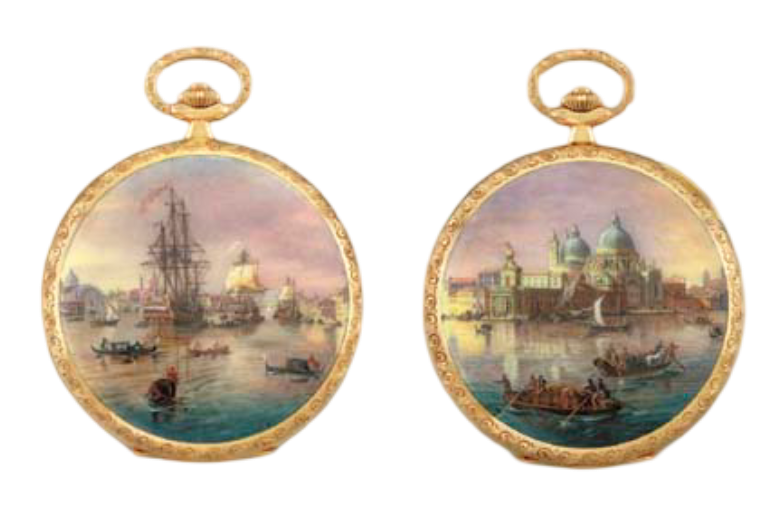
Ref. 865/115 “Views of Venice” after Caspar van Wittel (Vanvitelli). Image credit: Christie’s
In 1994, a timepiece featuring reproductions of two Ming era ceramics from the Edward T. Chow Collection, a Hong Kong collector who spent the later part of his life in Geneva, was delivered. Notably, the watch was made 14 years after Mr. Chow’s passing. Both ceramics are also featured on the covers of the auction catalogues documenting his collection. While remarkably precise, the enamel paintings are unsigned. Reference 865/216 sold at Christie’s in 2006 for $123,000.
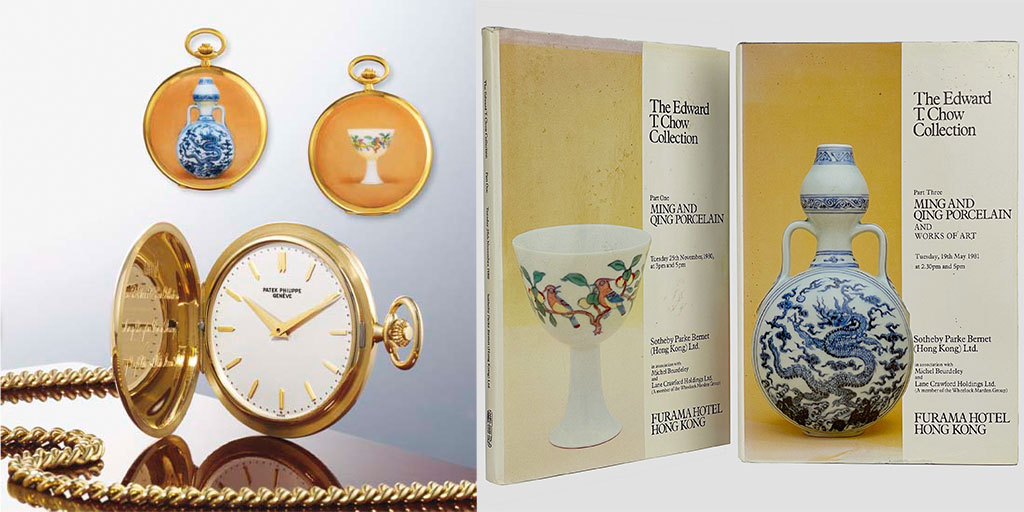
Ref. 865/216 Ceramics from the Edward T. Chow collection. Photo credit: Christie’s (watch), Sotheby’s (catalogues)
The last known double-faced timepiece was made by Suzanne Rohr and depicts “Maternity” after Alfred van Muyden (2002) and “Reading” after Pierre-Auguste Renoir (2004). This must be one of the last pieces made by Suzanne Rohr, who retired around this time. As prominent Patek Philippe collector @horology_ancienne, who commissioned the piece, recalls, the choice of artwork was left to Philippe Stern and Suzanne Rohr themselves. They selected some of their favorite paintings, making the piece particularly meaningful. The piece was on long-term loan to the Patek Philippe Museum.

Ref. 987/2 “Maternity” after Alfred van Muyden & “Reading”after Pierre-Auguste Renoir, both painted by Suzanne Rohr in 2002-04. Image credit: @horology_ancienne
Collectability
These timepieces with miniature enamel painting are rare, very rare. Over the course of 50 years, we can estimate that 200-250 pieces have been made, that is, an average of just 4 to 5 per year, with each design being unique. Of these, 133 are known, among which almost a third belong to museum collections: Patek Philippe Museum (36), Beyer Museum (1), and Musée International de l’Horlogerie (1).
The collector behavior is also much more like art, where works often stay in private collections for decades, if not longer. As evidence, in the course of the research for this article, only a handful of pieces appeared at auction more than once, showing how precious the pieces are to their owners. This also means that many pieces are still unknown – particularly special commissions but also regular pieces – and important discoveries are still to be made.
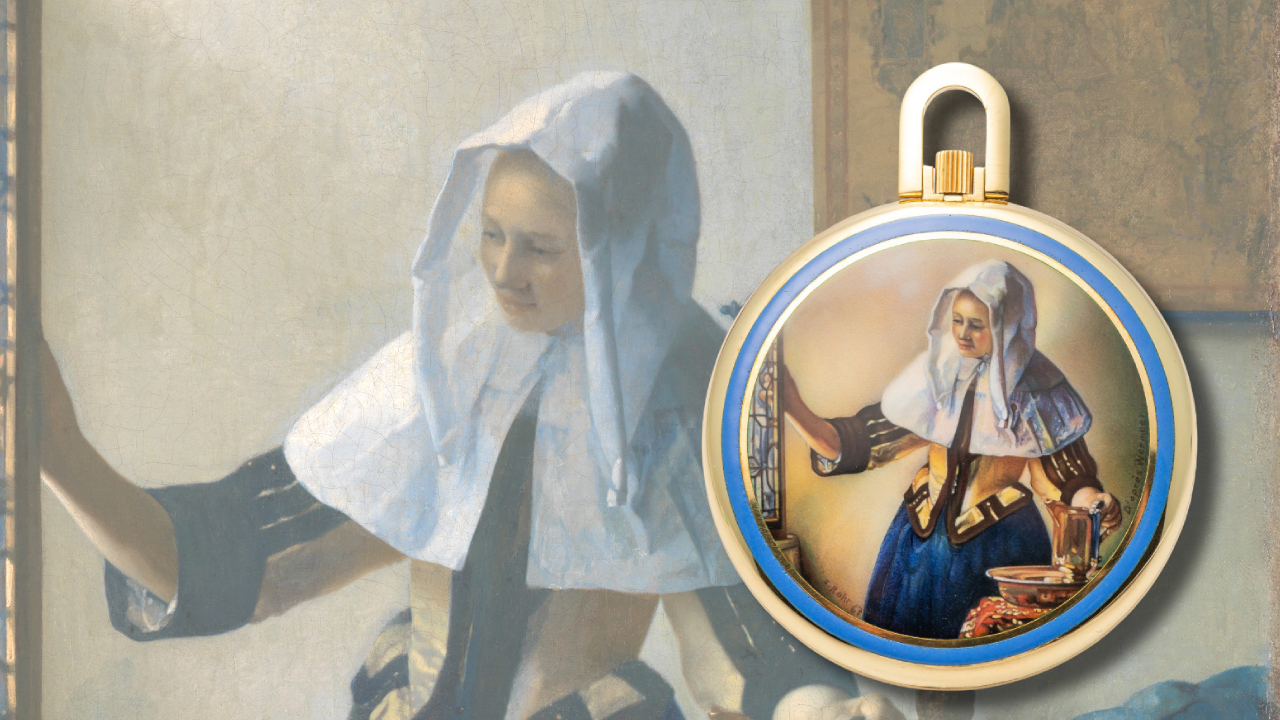
Every year, rarely more than one or two pieces appear at auction. The record for the most expensive piece, sold by Antiquorum in 2022 for a staggering $947,000, is held by “Woman with a water jug” after Johannes Vermeer, which was painted by Suzanne Rohr in 1967 and sold in 1971. Not only does this piece belong to the first pieces made by Suzanne Rohr, it also depicts one of the most famous paintings by one of the most revered painters ever and as such combines many very desirable features.
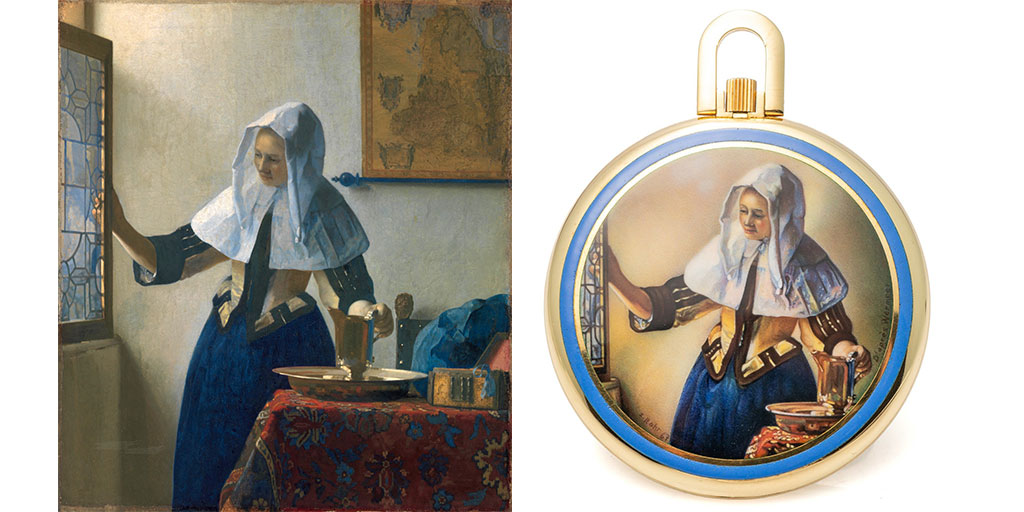
Record holding Ref. 715/3 “Woman with a water jug” after Johannes Vermeer by Suzanne Rohr. Image credit: Antiquorum
Beyond this extraordinary result, these rare enamel pieces have seen more and more appreciation in recent years, as a result of the renewed appreciation for rare handcrafts in general and a better understanding of the significance of these exceptional pieces, made at a time when miniature painting art had almost disappeared.
Due to the infrequency of the auction appearances and the subjective emotional component linked to how the subject of the artwork depicted resonates with individual collectors’ tastes, a certain volatility in the results is to be expected. While Suzanne Rohr is the most celebrated and recognized artist, the market values all artists similarly. That said, these pieces now frequently trade above $300,000, and several examples have sold above $500,000. As more and more collectors appreciate these pieces, I would not be surprised if the increase in prices accelerates in the coming years. One is advised to buy when a piece to their liking comes up for sale, as it will then likely not be seen again for several decades.
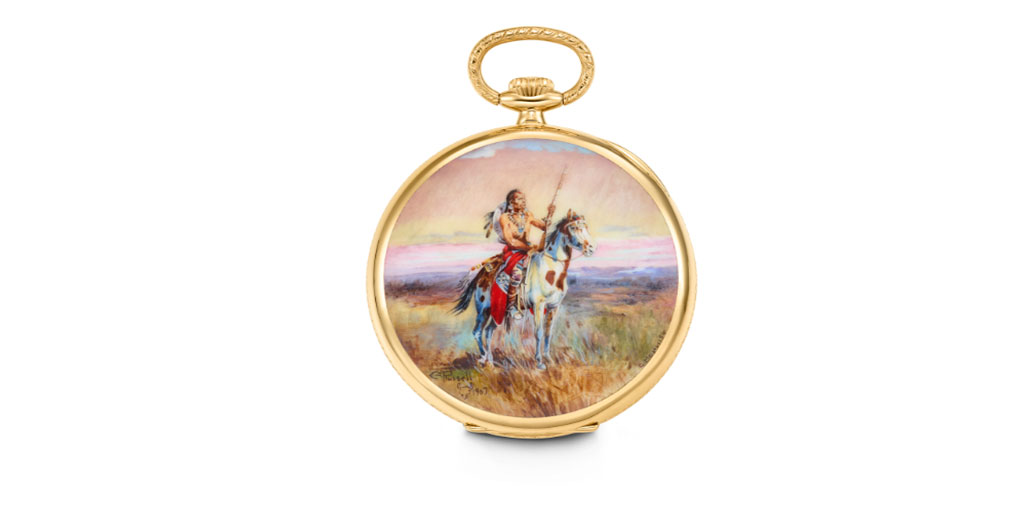
Most recently, in December 2025, a miniature enamel by G. Menni sold for $520,700. In 1994, G. Menni completed a miniature enamel for a special Patek Philippe Exhibition held in 1995 at the Sid Richardson Collection of Western Art Museum, Fort Worth, Texas. The pocket watch cover depicts a miniature enamel painting of ‘The Scout’ by Charles Marion Russell, a painting on display at the museum in Fort Worth.

Conclusion
The story of Patek Philippe’s miniature enamel pocket watches does not end in 2000. The tradition preserved through those difficult decades has since flourished beyond what even the Stern family might have imagined.
In 2003, Anita Porchet, Suzanne Rohr’s protégé, began painting and signing her own miniature painted enamel pocket watches for Patek Philippe, with early works depicting a series of antelopes and macaws. The mentor-mentee relationship that defined Suzanne Rohr’s own beginning had come full circle, ensuring the art would continue into a new generation.
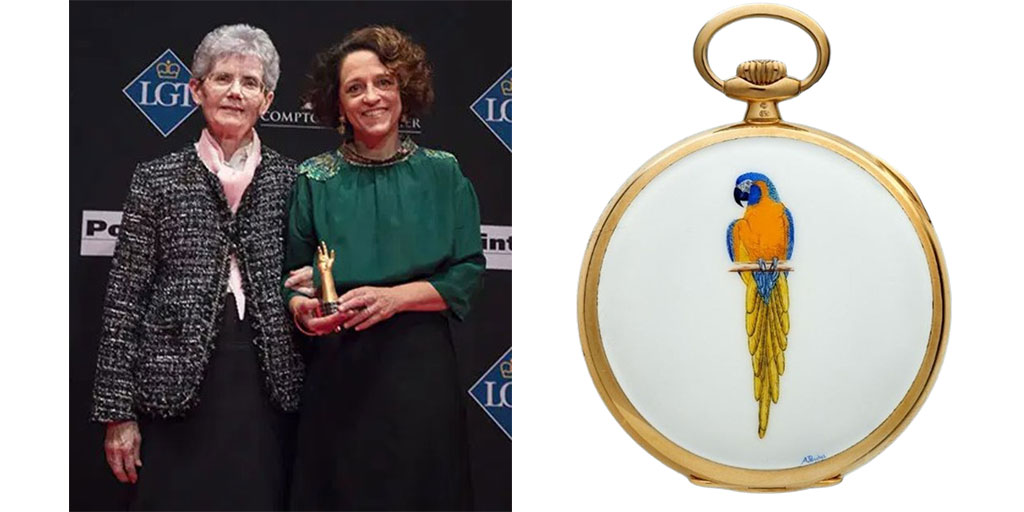
Suzanne Rohr and Anita Porchet winners at the GPHG 2017. Ref. 974 “Macaw”, ca. 2003, one of the first pocket watches with miniature enamel made and signed by Anita Porchet for Patek Philippe. Image credit: Collectability
Since 2011, with the introduction of the Rare Handcrafts collection, Patek Philippe has expanded its commitment to enamel miniatures significantly. The art form has been integrated into wristwatches, reaching new collectors and ensuring its continued vitality. What began as an act of preservation has evolved into a thriving tradition and the pocket watches created between 1950 and 2000 remain the foundation of this renaissance.
Note from Collectability: next month we will be publishing an article on Carlo Poluzzi, the master enamelist recognized as the greatest miniaturist of all time. Poluzzi was a personal friend of Henri Stern and would advise him on his early enamel acquisitions. Later, Henri’s son Philippe became one of the most important collectors of miniature enamels, inspired by his father’s collection. Philippe’s son Thierry, who now runs Patek Philippe, has inherited his father’s and grandfather’s love of miniature enameling and is perpetuating this rare and cherished skill to unprecedented levels. The Patek Philippe Museum proudly displays several miniature enameled pieces by Carlo Poluzzi.
Edouard Henn has been passionate about horology since his teenage years. He began his professional journey in the watch industry in Switzerland before transitioning to luxury retail across Europe and the Middle East. With a business education background, Edouard brings both product and collector’s perspective to his writing. Now based between Geneva and Paris, he enjoys sharing horological knowledge and connecting with fellow enthusiasts in the watch community.