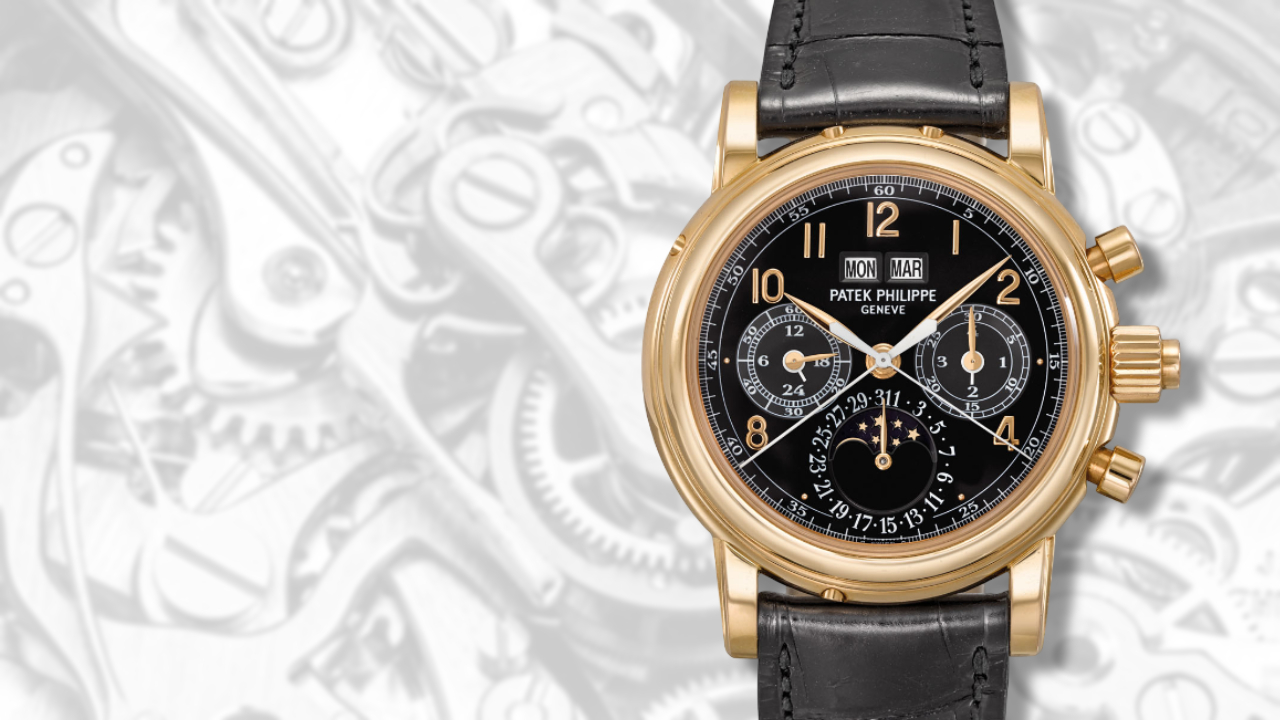
In 1994, Patek Philippe introduced a pivotal reference in its legendary perpetual calendar chronograph lineage: the ref. 5004, which added split-seconds functionality – one of horology’s most demanding technical challenges. This may appear deceptively simple: an additional hand, an extra pusher. The reality is far more complex, requiring precision engineering at the highest level.
The ref. 5004 emerged during a transformative period for Patek Philippe. Following the quartz crisis, Philippe Stern chose to return to mechanical excellence and increasingly ambitious complications. Based on the legendary Nouvelle Lemania 2310 caliber, Patek Philippe’s engineers undertook the considerable challenge of adding a split-seconds chronograph. The journey was not without obstacles: early examples needed refinement, leading to two distinct watch generations and three movement iterations throughout production from 1995 to 2012.
Despite its significance, the ref. 5004 has seldom been studied in detail and remains incompletely understood by collectors. This gap is particularly striking given recent developments: prices have increased dramatically in the past three years as the neo-vintage market has matured and collectors have recognized the ref. 5004’s importance in Patek Philippe’s modern history.
This comprehensive guide addresses this gap, examining the ref. 5004’s historical precedents and technical evolution, case and dial variations, the remarkable array of special orders, and detailed market analysis based on auction appearances and results. With an estimated 800-1000 pieces produced in six different metals, the ref. 5004 deserves the careful study this guide provides.
A Brief Historical Perspective
When unveiled at Baselworld 1994, the ref. 5004 became the first perpetual calendar split-seconds chronograph serially produced. Historically, Patek Philippe’s first split-seconds chronograph wristwatch was no. 124,824, made in 1923, while the first perpetual calendar wristwatch was no. 97,975 made in 1925. Both were major innovations at the time, requiring considerable engineering to adapt these complications to the wristwatch format. Patek Philippe continued this trajectory of innovation with the introduction of the ref. 1518 in 1941, the first serially produced perpetual calendar chronograph, a signature complication in which Patek Philippe maintains its dominance to this day.
Prior to the ref. 5004, only two split-seconds perpetual calendars are known, and both were special commissions. The first is the ref. 2571, an oversized perpetual calendar with split-seconds functionality, made in 1955. The iconic ref. 2499 had been launched four years earlier, initially with square pushers and then with round pushers from 1954. The ref. 2571 measured an unusually large 40mm for its time, featuring sloped lugs, square pushers, dauphine hands, and was based on the Valjoux 13-130 ébauche. Three examples are believed to have been made, one of which resides in the Patek Philippe Museum (No. 868,331).
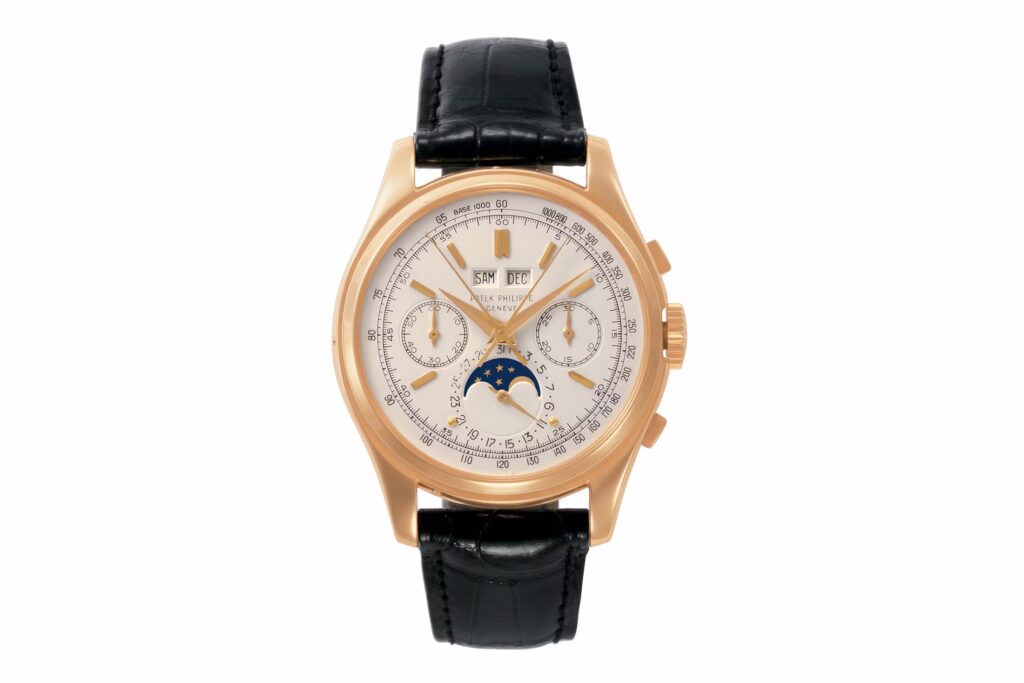
Ref. 2571: Patek Philippe’s first split-seconds perpetual calendar. Image credit: Patek Philippe Museum
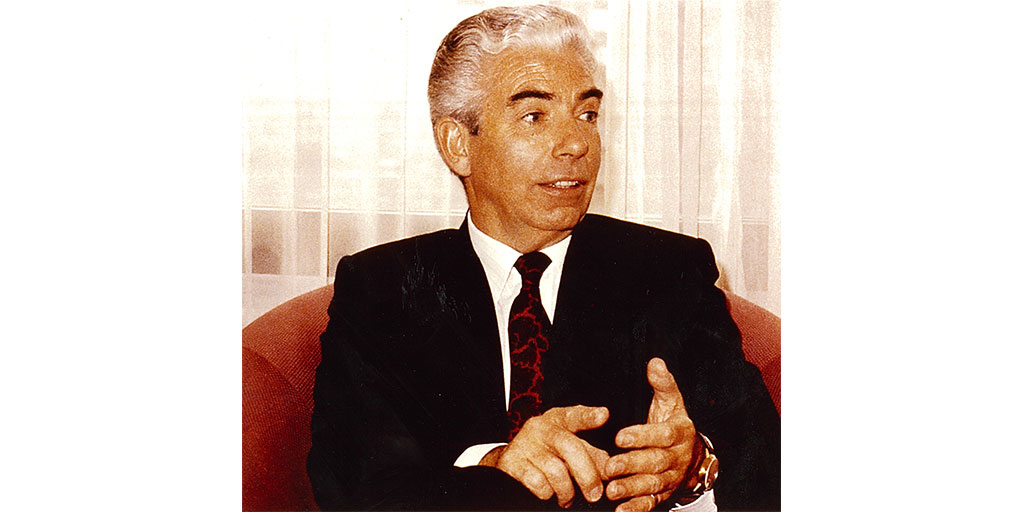
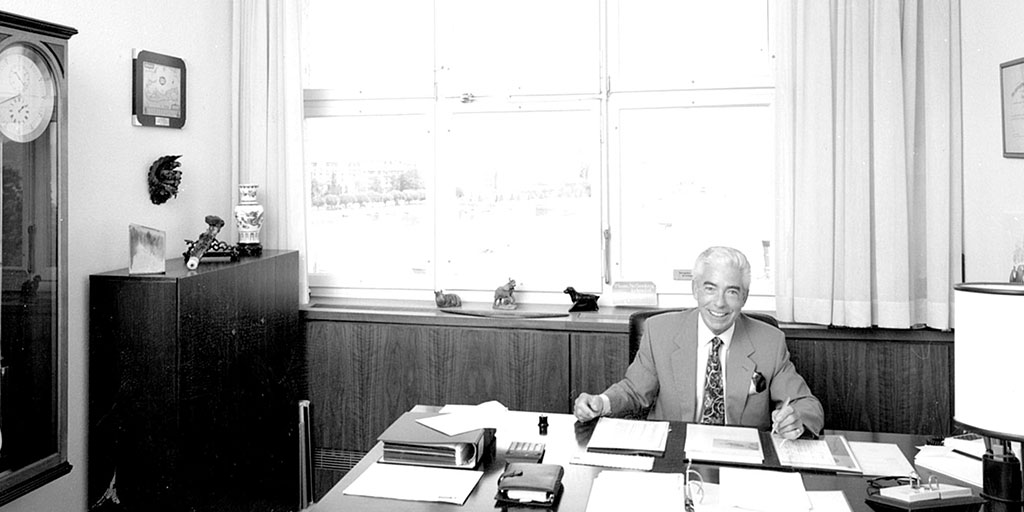
For the next three decades, the split-seconds perpetual calendar remained absent until the creation of the unique ref. 3973 (No. 2,855,688) in 1988-89 for Philippe Stern, then-President of Patek Philippe. This watch was also based on a modified Valjoux 13-130 and notably featured the split-seconds pusher co-axial with the crown. This development likely reflects Patek Philippe’s early vision to offer this complication in its collection. The ref. 3973 remains on permanent display at the Patek Philippe Museum.
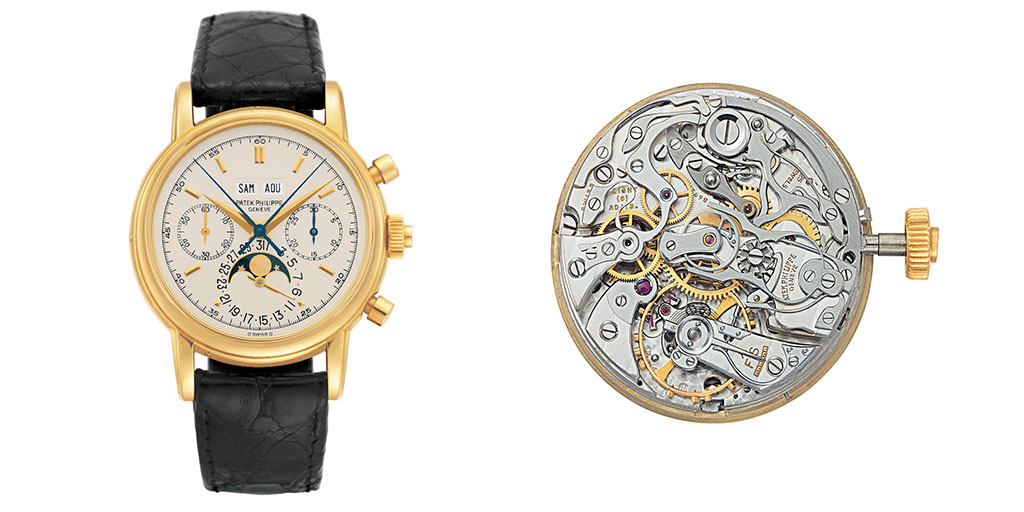
Unique ref. 3973 split-seconds perpetual calendar made for Philippe Stern in 1988-89. Image credit: Patek Philippe Museum
Watch Characteristics
Case
The case of ref. 5004 commands a distinctive presence. With a relatively compact 36.7mm diameter, it wears larger on the wrist thanks to the imposing crown. This impression is also reinforced by the 15mm height (2.2mm more than the ref. 3970), which is needed to incorporate the additional split-seconds mechanism.
The case features a distinctive multi-stepped construction. The profile is very similar to the ref. 3970, except with a convex bezel rather than a concave one, providing additional height for the movement. This design creates visual layers that add architectural interest while helping to disguise some of the watch’s thickness.
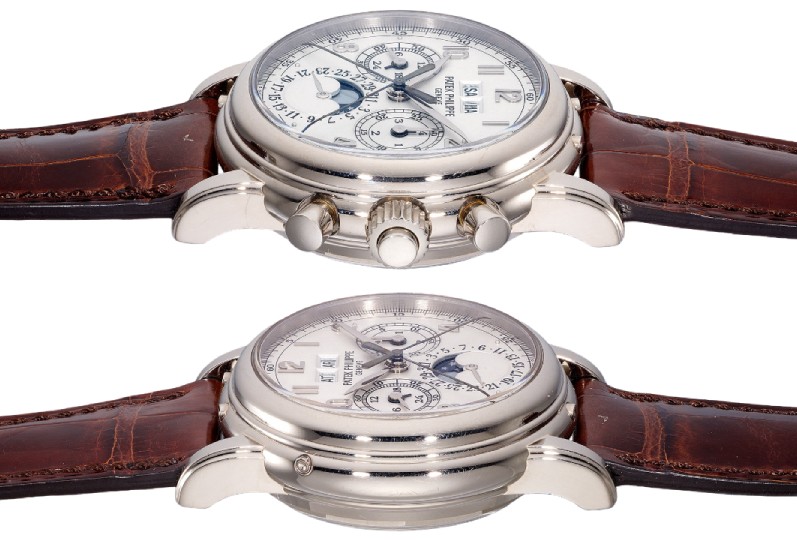
Ref. 5004 case profile. Image credit: Phillips
The round pushers for the start/stop and reset mechanism are very similar to the ref. 3970 and inspired by the fourth series ref. 2499. The additional rattrapante pusher is co-axial with the crown, ensuring fluid integration that preserves the overall symmetry.
The lugs – like those on the refs. 2499 and 3970 – are classic Patek Philippe: slim, slightly downturned, and beautifully beveled, elongating the case and ensuring comfort on the wrist.
The cases were manufactured by Guillod-Gunther SA (hammer number 121) before being taken in-house around 2009. Each watch came with two backs: a sapphire caseback mounted by default and an additional solid caseback.
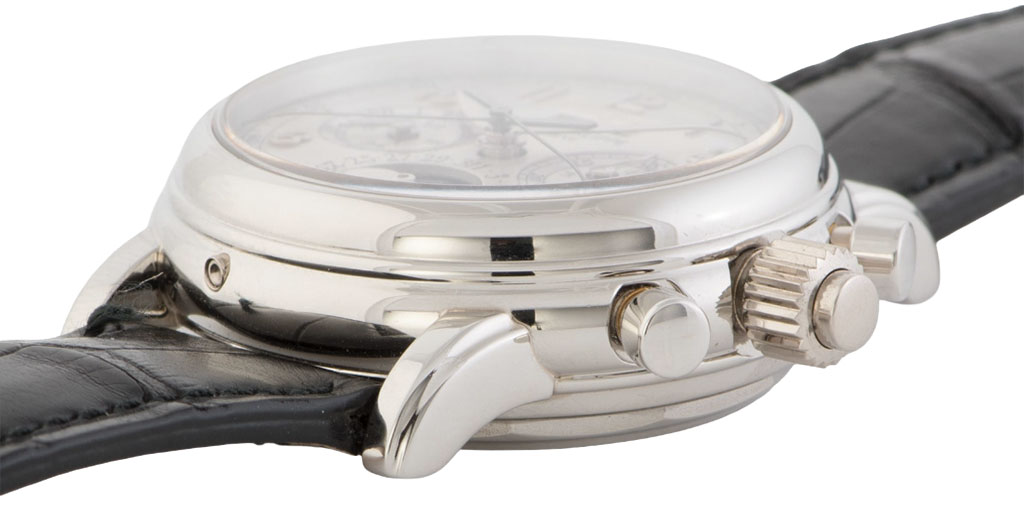
Ref. 5004 case profile details with lugs and pushers. Image credit: Phillips
Two crown versions can be distinguished:
- 1995-circa 1998: small crown
- circa 1998-2012: large crown
The crown was redesigned as part of technical improvements to enhance reliability and ergonomics. While the small crown extends approximately to the level of the pushers, the large crown protrudes significantly beyond them. This larger crown gives the watch its characteristically bold presence.
From its launch until discontinuation, the watch was offered in platinum, 18K yellow, rose, and white gold. A short end-of-series edition in steel was produced in 2012, while a unique titanium piece was created in 2013.
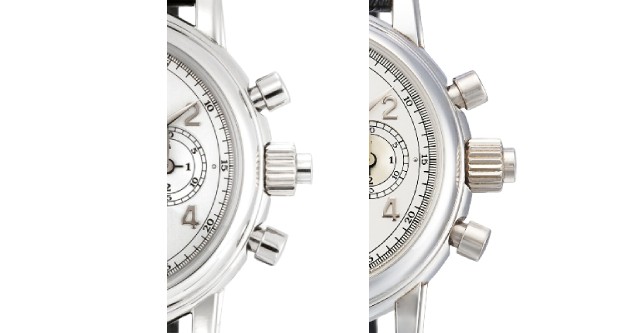
Left: 1st generation small crown; Right: 2nd generation large crown. Image credit: Sotheby’s
Dial
Structurally, the dial of the ref. 5004 is similar to the ref. 3970, but incorporates details that deliberately echo the ref. 1518 and ref. 2499, giving it a unique and immediately recognizable personality, characterized by the large Arabic numerals on silver dials.
The overall layout is typical of Patek Philippe’s perpetual calendar chronographs: twin day and month windows at 12 o’clock, a date and moon sub-dial at 6 o’clock, and chronograph minutes and leap year sub-register at 3 and small seconds and day/night at 9 o’clock. The applied Arabic numerals are directly modeled on the ref. 1518, though larger and rendered in a distinct modern font. Small cabochons mark the other hours. These Arabic numerals are what fundamentally differentiate the ref. 5004 from the ref. 3970.
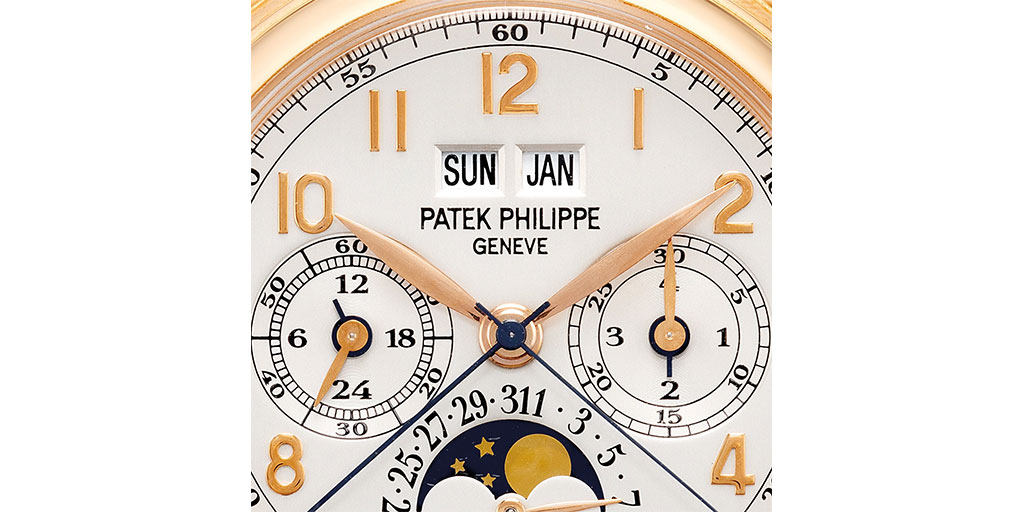
Characteristic ref. 5004 dial with large Arabic numerals, here on a rose gold example. Image credit: Phillips
The day and month indications were available in English, Italian, French, and German. English is by far the most common, followed by Italian; French and German examples are particularly rare.
One regular production variant from the catalog deviated from this main scheme: ref. 5004P-033 features a black dial with all numerals and cabochons replaced by round diamonds, except at 12 o’clock, where it features a baguette diamond.
Off-catalog dial configurations will be discussed in the special orders section.
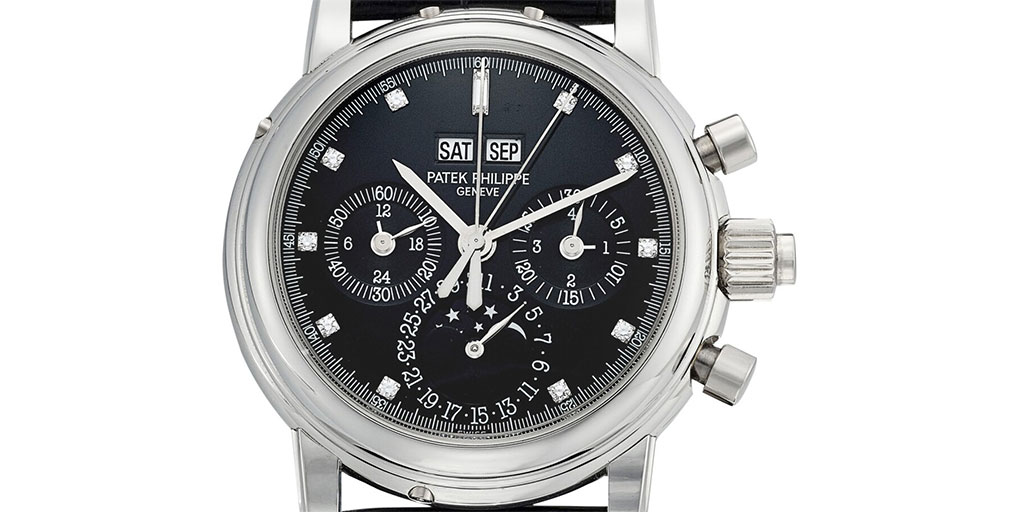
Ref. 5004P-033, the regular catalog black dial with diamond indices available exclusively on platinum. Image credit: Sotheby’s
Moon Phase
The moon phase color varies by case material:
- Yellow and rose gold: yellow moon
- White gold, platinum, steel: silver moon
Notably, some early white gold and platinum examples produced until ca. 1998 also feature yellow moons.
Early examples feature a moon phase with a black contour around the moon and stars, while from circa 2008 onward, a frosted finish replaced the black contour, adding greater depth.
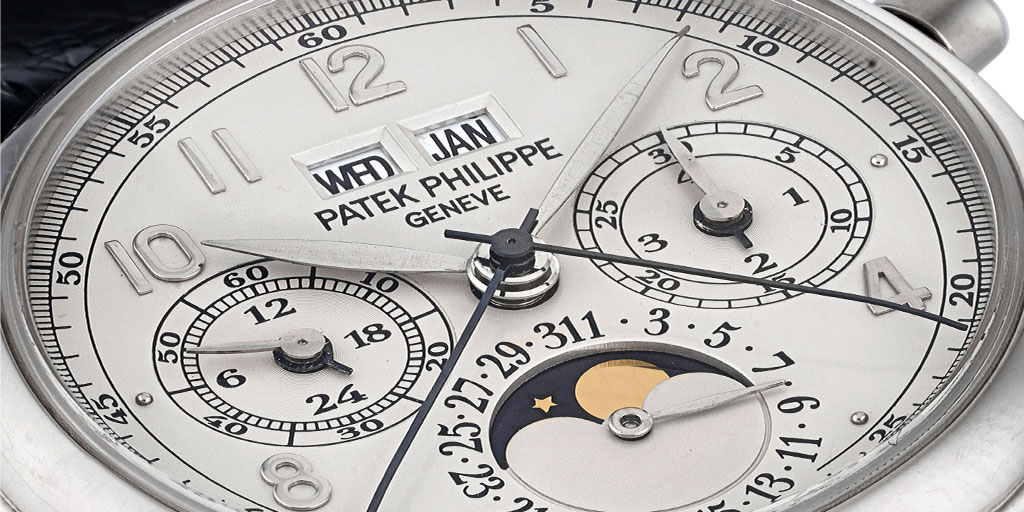
An early white gold example with yellow moon phase. Image credit: Christie’s
Hands
The ref. 5004 features a total of nine hands to display the time, perpetual calendar, and chronograph:
- Center: hour (leaf); minute (leaf); chronograph seconds (baton); chronograph rattrapante (baton)
- 9 o’clock: small seconds (leaf); day/night (baton)
- 3 o’clock: chronograph minutes (leaf); leap year (baton)
- 6 o’clock: date (leaf)
Two types of hands are used on the dial: leaf-shaped hands with an organic, classical, elegant aesthetic that takes direct inspiration from the ref. 1518 and ref. 2499, and baton hands with a clean, minimalist, modernist aesthetic. This ensures excellent legibility despite the substantial amount of information displayed.
In regular production gold models, the leaf hands match the color of the case. On silver dials, the baton hands are either blued or blackened, while on black dials they are white. On the steel models, all hands are blackened.
A notable exception to the leaf/baton combination exists: models featuring black dials with baton indices (ref. 5004G-015, ref. 5004P-039) and black dials with diamond indices (ref. 5004P-033, ref. 5004P-032) were generally delivered with baton hour and minute hands, creating a more cohesively modernist appearance. The other hands follow the previously described scheme. A few examples with these dials have been observed with the regular leaf hands, though it is unclear whether this is how they were delivered originally or the result of a change during servicing.
Two generations of hands can be distinguished, showing continued technical improvements:
- 1995–circa 1998: short chronograph hands
- circa 1998–2012: long chronograph hands
The first generation is characterized by short chronograph hands, which end right after the pivot. The second generation, in contrast, features a long counterweight on the opposite side of the pivot. This is an important technical improvement because the hands become better balanced around their center of rotation. It decreases wear, improves accuracy, and prevents the chronograph hand from drooping or changing position as a result of the reset. Aesthetically, the hand is more elongated and appears more complete. Due to this technical upgrade, short hands are sometimes replaced by long hands during servicing.
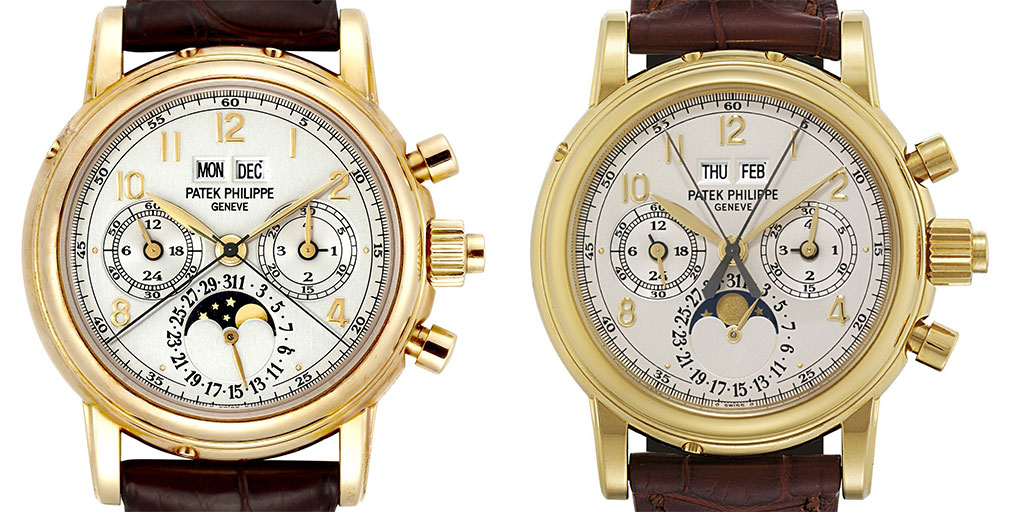
Left: 1st generation short hand; Right: 2nd generation long hand. Also note the moon
with black border on the left and the frosted moon on the right. Image credit: Christie’s
Movement
The movement of the ref. 5004 is based on the legendary, hand-wound Nouvelle Lemania 2310. Patek Philippe started using this base movement in 1986 for the ref. 3970. Patek Philippe renamed the movement CH 27-70 Q and heavily modified it: not only did the manufacture add its own perpetual calendar module, but it also reworked the mechanism to increase power reserve and improve the finishing to meet Geneva Seal standards.
For the ref. 5004, Patek Philippe’s engineers undertook the additional challenge of adding a split-seconds function (“rattrapante” in French), which allows the timing of two separate events that start simultaneously, such as two runners in a race. The new movement was named CHR 27-70 Q, with the R denoting Rattrapante.
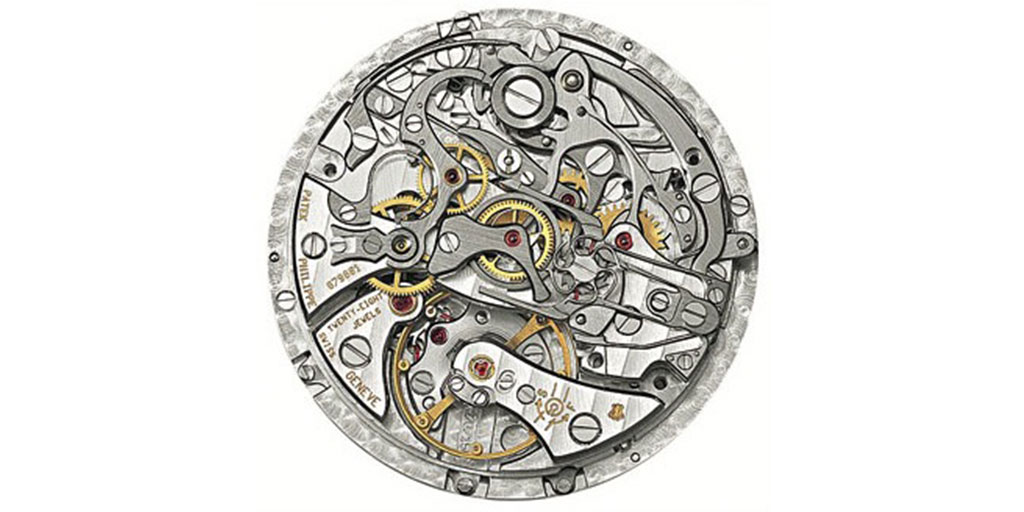
Patek Philippe CHR 27-70 Q split-seconds perpetual calendar based on the Lemania 2310. Image credit: Patek Philippe
Because it adds an entire mechanism to control a second chronograph hand, a split-seconds chronograph is far more challenging to manufacture. The main difficulty lies in managing friction and energy so the split-seconds hand can be clamped and released without disturbing the main chronograph, affecting the amplitude, or compromising the reliability of this sensitive mechanism.
Since the Lemania movement was not initially conceived as a split-seconds chronograph, this brought its own set of challenges in terms of assembly, regulation, and reliability. The first movements were not quite as reliable as one might reasonably expect, and Patek Philippe’s engineers continually refined them. Three movement generations have been produced, identifiable by the shape of the rattrapante bridge:
- 1995-circa 1998: wide block
- circa 1998-circa 2004: V-shaped
- circa 2004-2012: elongated, also connected to the octopus
As these are critical technical improvements for ensuring reliability, the mechanism is usually upgraded by Patek Philippe during servicing, unless the client requests otherwise.
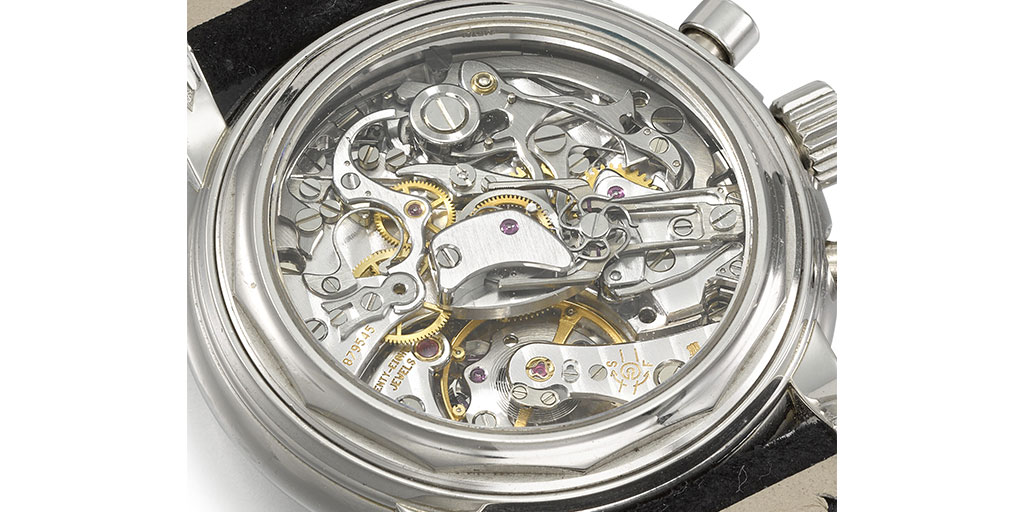
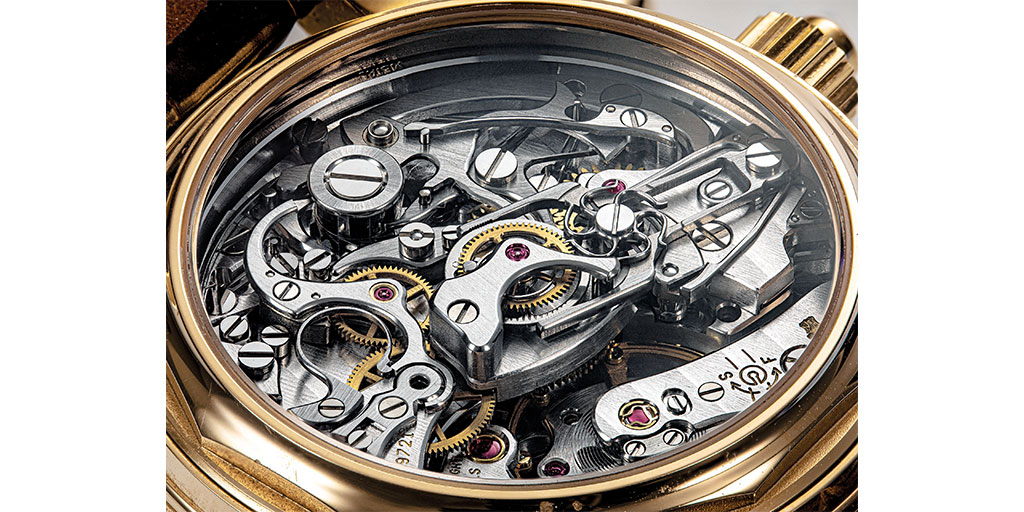
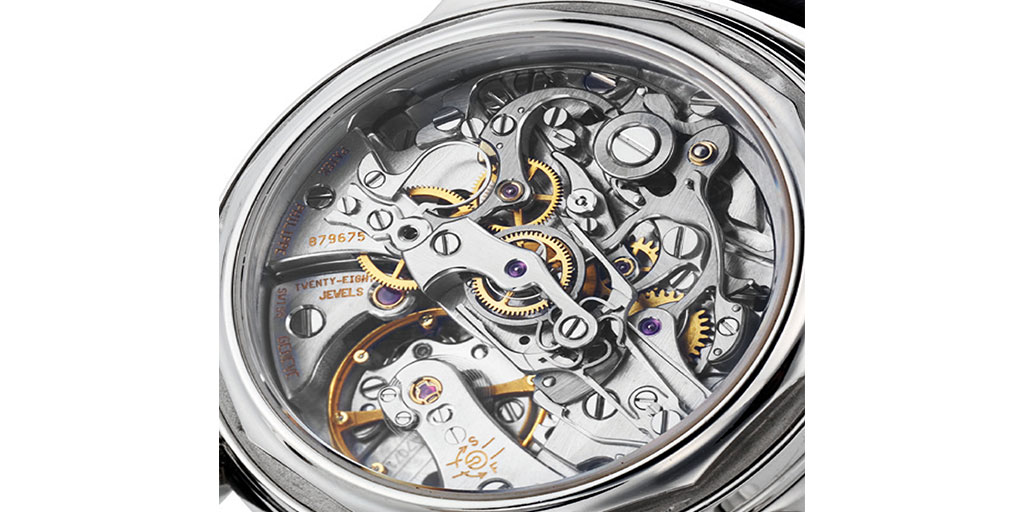
The finishing is extraordinary, and collectors are encouraged to use a loupe when handling the ref. 5004 to admire the level of precision and detail invisible to the naked eye. Every component is decorated, highlighting the beauty of the movement and its three-dimensional architecture. All movements meet Geneva Seal standards, even those found on watches produced after the introduction of the Patek Philippe Seal in 2009.
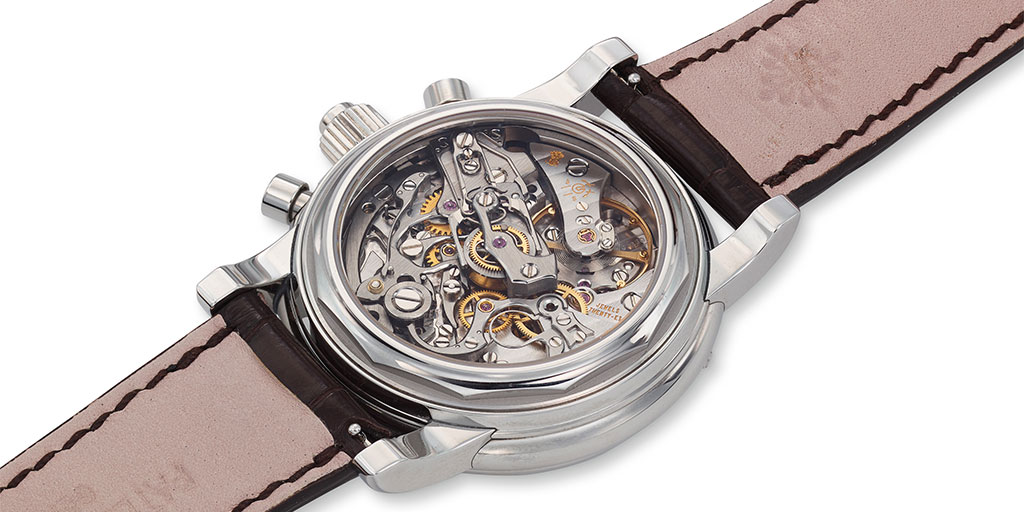
All ref. 5004 movements were finished to the Geneva Seal standard. Image credit: Collectability Archives
Accessories
Ref. 5004 watches were delivered with leather straps and folding buckles matching the case material.
A few platinum, yellow gold, and white gold bracelets were fitted at clients’ request. These bracelets were specially designed to sit perfectly flush with the case with no visible gap and feature recessed areas allowing continued operation of the pushers to adjust the calendar. These bracelets were very expensive at retail, and only a handful were produced.
The full set is composed of the Certificate of Origin, a wooden box, product literature in a leather folder, a second caseback and a pushpiece used to set the calendar. While not always present on a watch that is now 30 years old, collectors are always encouraged to look for complete examples. In case the Certificate of Origin is not available, collectors are advised to request an Extract from the Archives to buy with confidence.
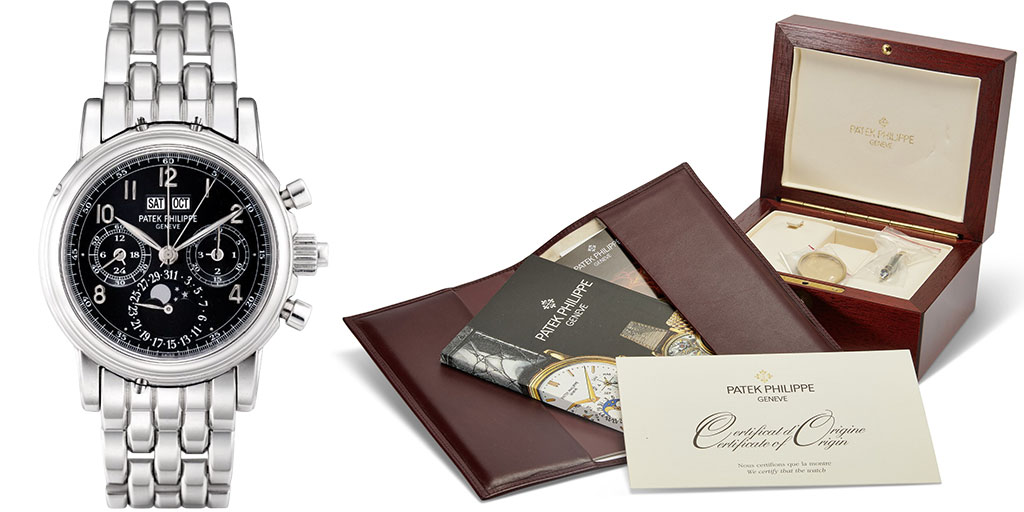
Left: a white gold bracelet on an off-catalogue black dial. Image credit: Phillips
Right: the full set. Image credit: Christie’s
Generations Summary
The ref. 5004 evolved through distinct generations, each representing technical improvements in reliability and performance. Though based on collector observations rather than official Patek Philippe classifications, these generations offer a practical framework for identification.
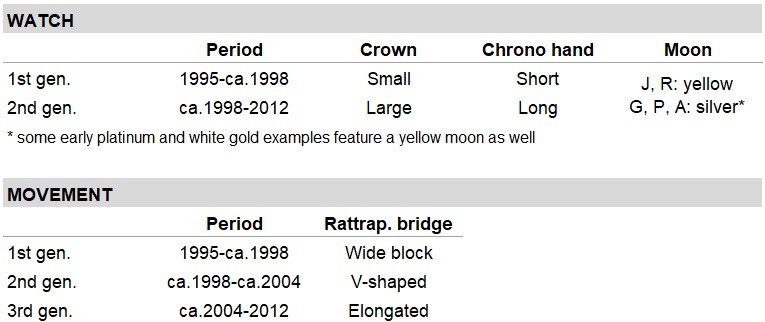
Transitional pieces exist featuring mixed-generation characteristics, such as large crowns with short hands. These may be factory-delivered configurations or the result of parts replacement during servicing.
Collectors must balance originality against functional benefits when servicing their watch. While movement upgrades significantly improve reliability, collectors preferring original configurations can request these be retained, which Patek Philippe generally tries to accommodate when technically feasible.
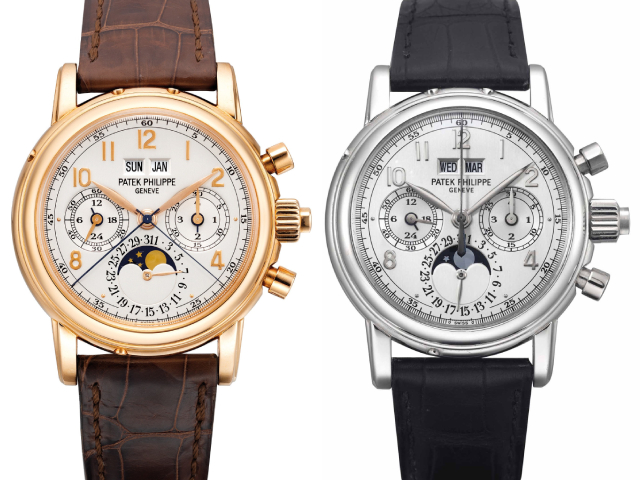
Left: 1st generation short hands, small crown. Image credit: Phillips Right: 2nd generation: long hands, large crown. Image credit: Christie’s
Variations & Special Editions
The variations of the ref. 5004 reveal fascinating insights, and many variants are known to exist. This reflects both Patek Philippe’s policies from the mid-1990s to the early 2010s and demonstrates that the ref. 5004 was not an easy sale at the time, prompting considerable effort to help retailers accommodate client requests.
Special series can be classified into three main categories: the black dial series, the steel case series, and special orders with additional personalization.
Steel ref. 5004A-001 Short Series
Outside of sports models and the Twenty~4, steel has historically been reserved for special pieces at Patek Philippe. Prior to discontinuing the Lemania-based ref. 5004 in 2012, Patek Philippe created a special end-of-series edition in steel. The silver dial features applied blackened baton markers, with all hands blackened as well. These watches were all sold through the Patek Philippe Salon in Geneva and reserved for the manufacture’s most important clients, who typically had their names engraved on the sapphire caseback. Production likely spanned between 2012 and 2014, and fifty to eighty pieces are believed to have been produced, though this number has not been confirmed by Patek Philippe. These watches are considered grail pieces by many collectors.
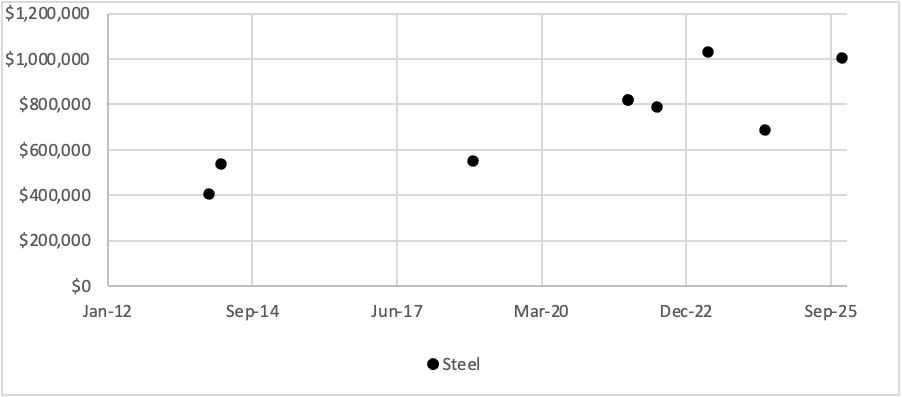
The watch was sold ten times at major auction houses (eight unique examples) and consistently attracts significant collector interest. The most recent example sold at Christie’s in 2025 for $1,004,000.
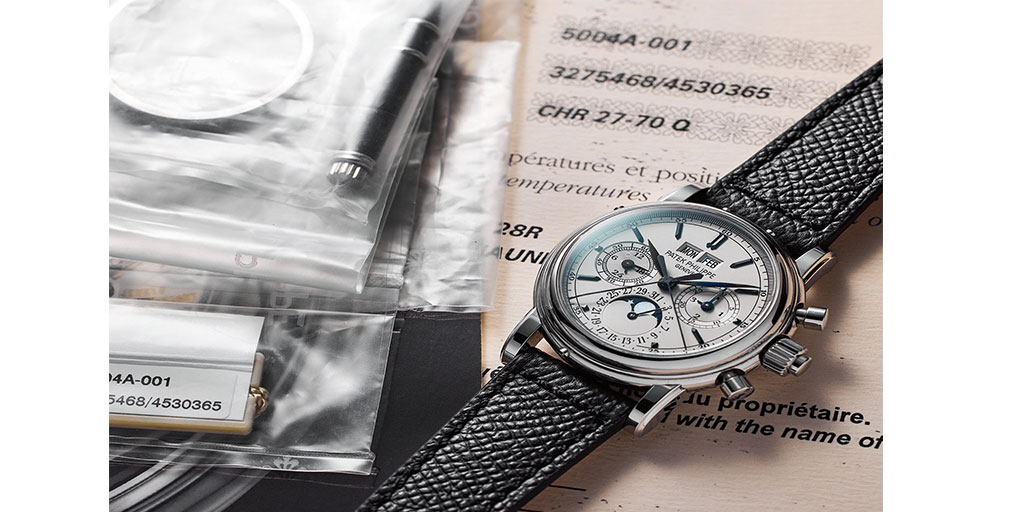
Ref. 5004A-001 in steel recognizable by the silver dial with blackened indexes and hands. Image credit: Phillips
Black Dial Short Series
One black dial was offered in the regular catalog and should not be confused with special orders: instead of the Arabic numerals and cabochons, it features ten round diamond indices and baguette diamonds at 12 o’clock. This dial was available exclusively in platinum and featured baton hour and minute hands instead of leaf hands. It carries the ref. 5004P-033, and the dial is described as “NOIR – 1 BAG. + 10 DIAMANTS – ANG” on the Certificate of Origin. Fifteen examples have appeared at major auction houses (see picture in dial section).
The regular dial with its characteristic large Arabic numerals was also made in black and is described as “NOIR – HEURES ARABES – ANG” on the Certificate. It has most commonly been seen in platinum (ref. 5004P-022, fifteen pieces known at auction) and rose gold (ref. 5004R-018, eleven pieces). Both were available from ca. 1997. A single yellow gold example has appeared at auction, while no white gold example is known.
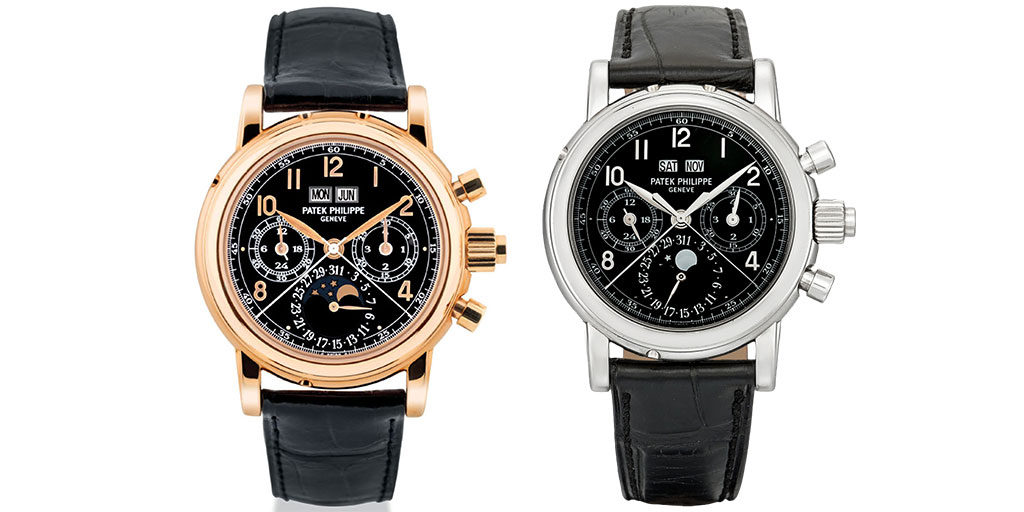
Ref. 5004R-018 and ref. 5004P-022 with black dials. Image credit: Christie’s, Sotheby’s
A black dial with applied baton indices was also produced: instead of the Arabic numerals and cabochons, it features elongated applied indices, similar to the regular ref. 3970 dials. The Certificate of Origin reads “NOIR – HEURES RELIEF OR – ANG”. These were available in white gold (ref. 5004G-015, twelve examples known) and platinum (ref. 5004P-039, three examples known).
The final black dial made in a limited series features seven baguette diamonds replacing the Arabic numerals, with the cabochon positions left blank. Three examples have appeared at auction (ref. 5004P-032, “NOIR – 7 BAGUETTES DIAS. – ANG”). Interestingly, these have been observed in watches from both the first and second generations.
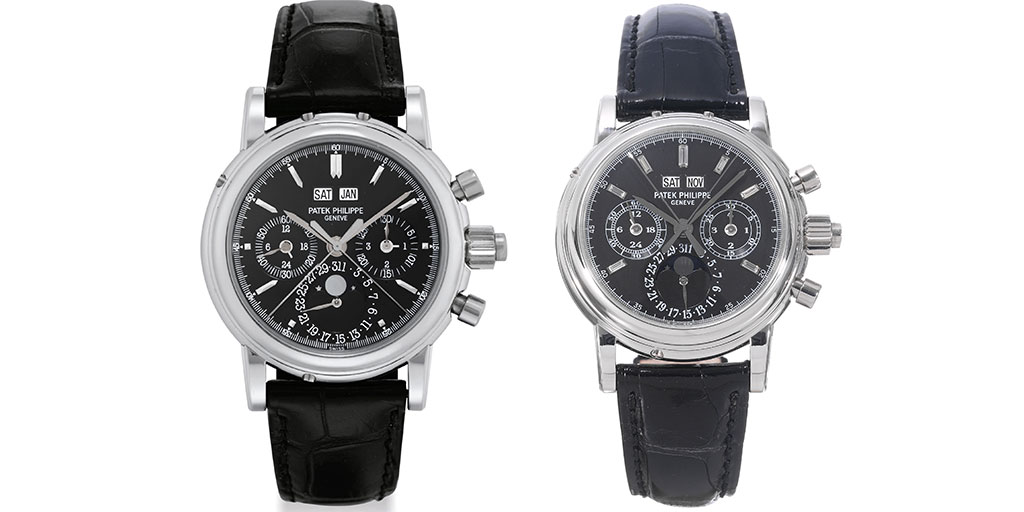
Left: Ref. 5004P-039 with applied indices; Right: Ref. 5004P-032 with baguette diamonds. Image credit: Christie’s, Antiquorum
Special Orders
The ref. 5004 is certainly one of the references for which most special orders have been made. While known examples will be described below, Patek Philippe has not publicly disclosed information about these pieces, and collectors often prefer to keep their commissions private. Consequently, this list is by no means exhaustive, and important discoveries are to be expected. It should be noted that these pieces are not necessarily unique, and while multiple examples of certain configurations may exist, all are extremely rare and rarely seen.
Titanium Only Watch
For the 2013 edition of the Only Watch charity auction, which funds research into Duchenne muscular dystrophy, Patek Philippe created the unique ref. 5004T-001. It is the only known ref. 5004 in titanium and is distinguished by its black hand-guilloché carbon-pattern dial and red chronograph hand, giving it a sporty character that stands out among the more classical executions. It holds the record for the most expensive ref. 5004 sold at auction, realizing 2.95 million euros in October 2013.
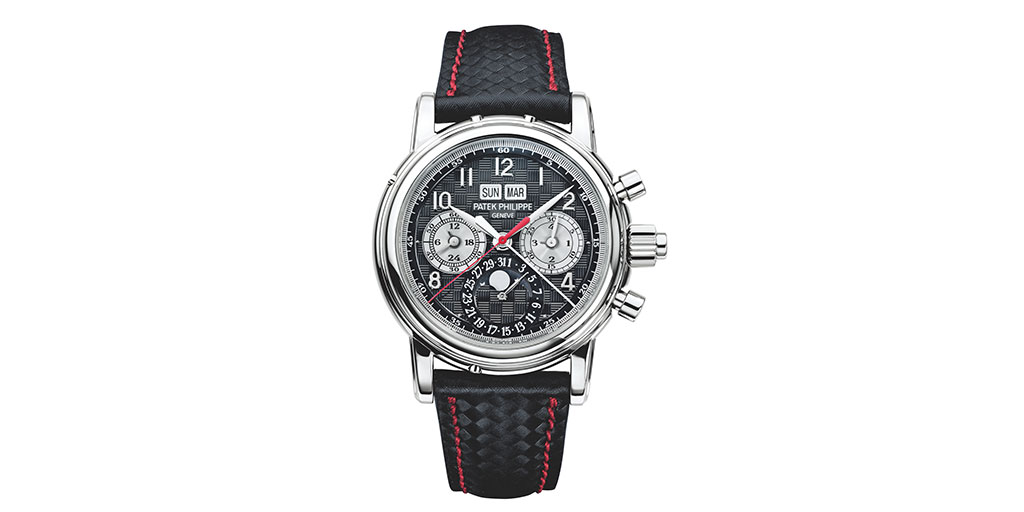
The unique ref. 5004T-001 and only known piece made in titanium. Image credit: Patek Philippe
Roman and Breguet Numeral at 12 with Tachymeter
Two important ref. 5004 watches commissioned by famed musician and prominent watch collector Eric Clapton are known. Delivered in 2011, they are characterized by a Breguet numeral at 12 o’clock, cabochon hour markers, and a large tachymeter scale around the dial. The two versions are:
- Rose gold, black dial – sold at Phillips in 2016 for $404,000
- Platinum, blue dial – last sold at Sotheby’s in 2021 for $978,000
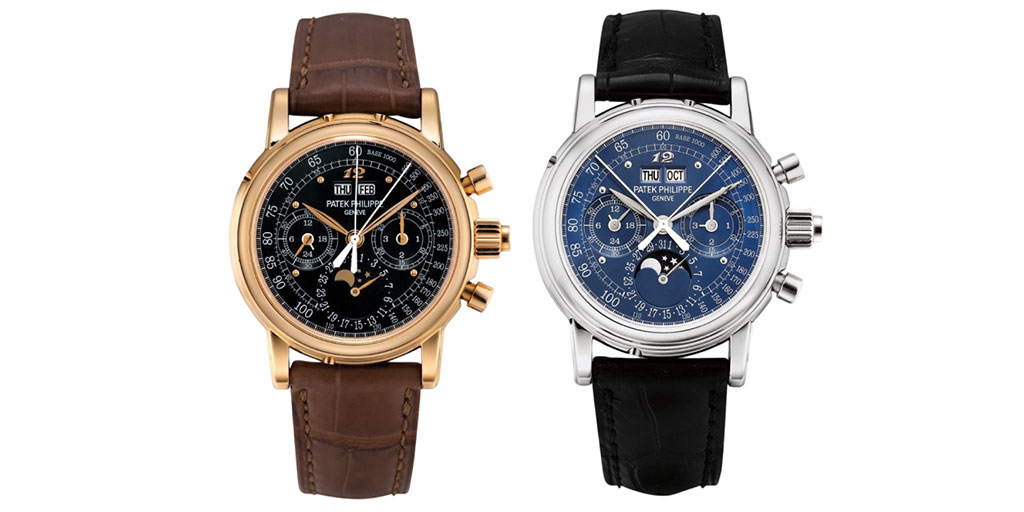
Eric Clapton’s refs. 5004 special order with Breguet 12 and tachymeter. Image credit: Phillips
A set of four ref. 5004 watches was made in 2009 and is characterized by a Breguet numeral at 12 o’clock, cabochon hour markers, and a large tachymeter scale around the dial. The four pieces are in the following configurations:
- Yellow gold, doré dial (ref. 5004J-018) – last sold at Christie’s in 2019 for $598,000
- Rose gold, black dial (ref. 5004R-024) – last sold at Christie’s in 2025 for $890,000
- White gold, salmon dial – last sold at Sotheby’s in 2015 for $413,000
- Platinum, blue dial – last sold at Christie’s in 2012 for $545,000
Beyond these, an additional example in platinum with a blue dial and platinum bracelet is known, as well as a yellow gold model with a black dial and bracelet.

Four-piece ref. 5004 set with Roman XII and tachymeter. Image credit: Christie’s
Michael S. Ovitz, founder of the CAA talent agency and briefly Disney CEO, commissioned special variants of the ref. 5004. They all follow the same personalization scheme: a Roman numeral at 12 o’clock, cabochon hour markers with extra luminous dots, a large tachymeter scale around the dial, and luminous hands. They also feature his signature MSO monogram at 6 o’clock. Five versions are known – all dated April 15, 2011, on the certificate. These were resold shortly after initial delivery, mostly double-sealed or unworn:
- Yellow gold, black dial (ref. 5004J-017) – last sold at Christie’s in 2023 for $1,194,000
- Yellow gold, black dial, bracelet (ref. 5004/1J-001) – European Watch Company
- White gold, slate dial, bracelet (ref. 5004/1G-001) – sold at Phillips in 2017 for $605,000
- White gold, salmon dial – Forbes
- Platinum, black dial (5004P-041) – last sold at Christie’s in 2025 for $1,489,000
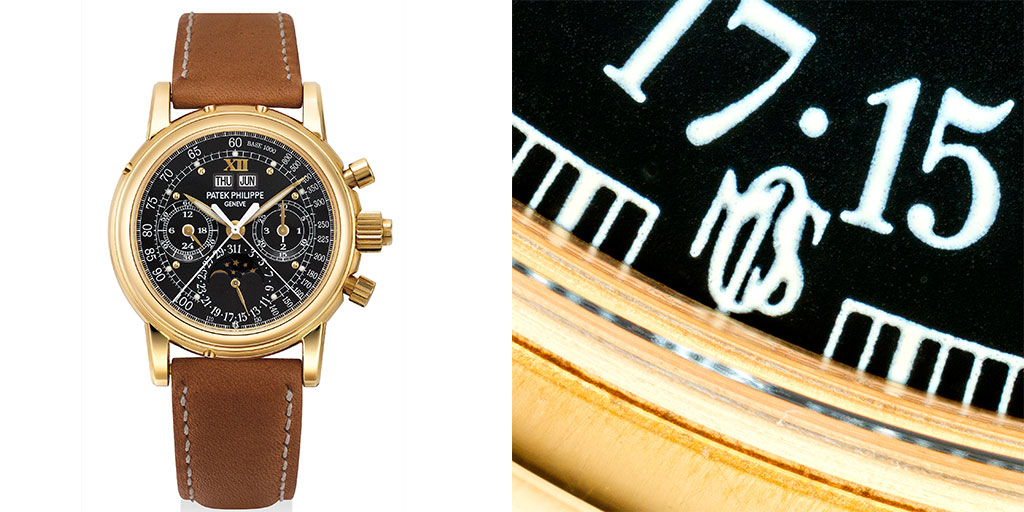
Ref. 5004J-017 with MSO monogram at 6. Image credit: Christie’s
Gem-Set Dials
Based on a design similar to the ref. 5004P-033 with black dial and diamond indices, two early special orders were produced with gem-set silver dials:
- Platinum, silver dial, diamonds, circa 1998 – sold at Christie’s in 2020 for $371,000
- Rose gold, silver dial, rubies, circa 2001 – sold at Christie’s in 2021 for $350,000
According to renowned Patek Philippe collector and scholar @horology_ancienne, he commissioned a four-piece set around 2007, based on a similar design with gemstone hour markers. At least the ruby version was likely produced in more than one example.
- Yellow gold, silver dial, yellow sapphires (ref. 5004J-015)
- Rose gold, silver dial, rubies (ref. 5004R-022)
- White gold, silver dial, blue sapphires (ref. 5004G-017)
- Platinum, silver dial, black diamonds (ref. 5004P-038)
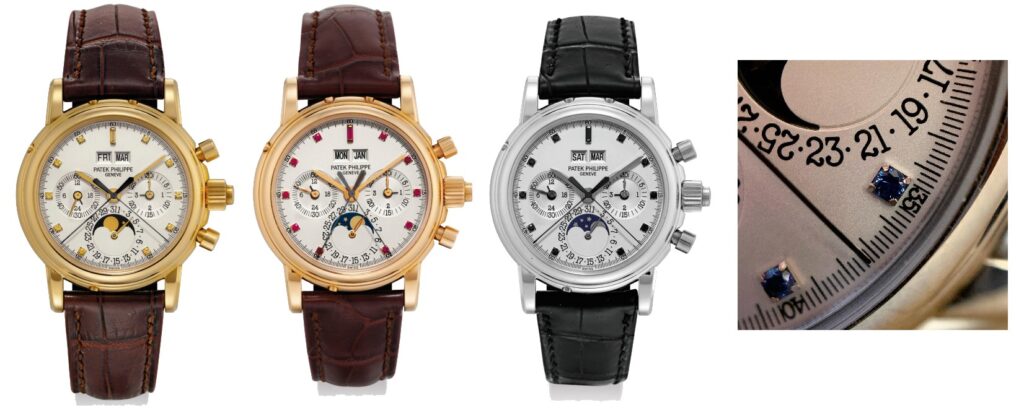
Four pieces gem-set ref. 5004. Image credit: Christie’s (watches), @horology_ancienne (white gold and blue sapphire detail)
Full Breguet Numerals
Breguet numerals are one of Patek Philippe’s strongest signatures and are only offered on rare occasions. Two prominent collectors have commissioned ref. 5004 watches with full Breguet numerals, with spectacular results:
- Platinum, black dial, full Breguet numerals – @roni_m_29
- Platinum, black dial, full Breguet numerals, all printings in red, red hands – @horology_ancienne
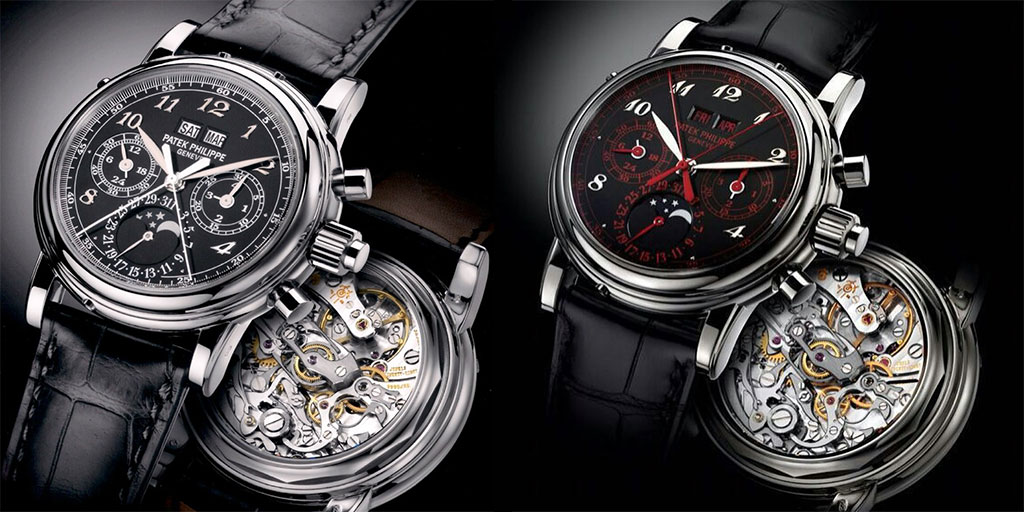
Special order 5004 in platinum with black dials and full Breguet numerals. Image credit: @roni_m_29 (silver), @horology_ancienne (red)
Pulsation Scales
A pulsation scale allows doctors and medical professionals to easily measure a patient’s heart rate using the chronograph. While less common today, it has been used on some of the most iconic Patek Philippe watches like the ref. 130 and ref. 1463. Two examples of the ref. 5004 are known in which the outer scale and main numerals were removed to accommodate a large pulsation scale:
- Rose gold, silver dial, Arabic 12, luminous hands, Italian calendar – @only_therarest
- Rose gold, black dial, Breguet 12 (5004R-028) – Sotheby’s in 2018
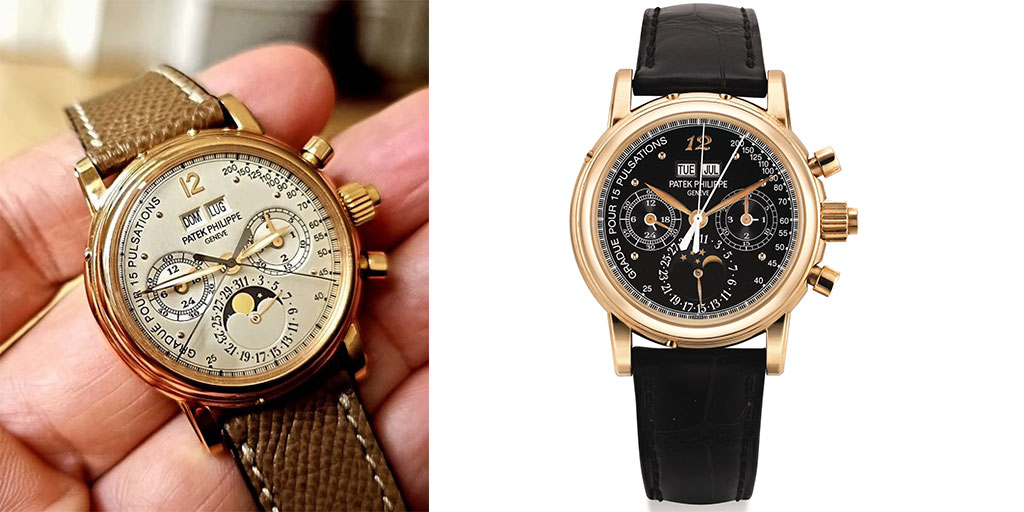
Ref. 5004 with pulsation dials. Image credit: @only_therarest (left), Sotheby’s (right)
Arabic Numerals Variations
Additional special orders feature variations on the main ref. 5004 dial design with large Arabic numerals, ranging from subtle to bold:
- White gold, salmon dial, Italian calendar – sold at Christie’s in 2001 for $131,000. This watch is notable for having been made in 1996 and is therefore one of the earliest special orders
- White gold, salmon dial, black numerals – sold at Phillips in 2015 for $423,000
- White gold, salmon dial, luminous hands – commissioned by John Mayer
- Platinum, brown dial (5004P-061) – sold at Sotheby’s in 2019 for $557,000
- Platinum, black dial, red 12 numeral (5004P-046) – Kinsmen
- Platinum, black dial, red 1 numeral, “A mon fils” (5004P-044) – @remyjulia_watch_specialist
- Platinum, black dial, red 2 numeral, “A mon fils” (5004P-045) – The Keystone
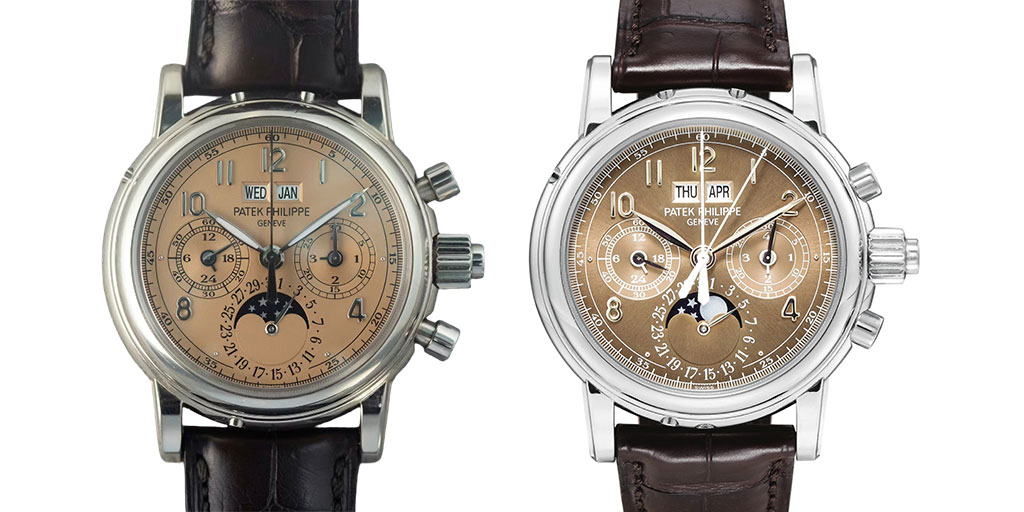
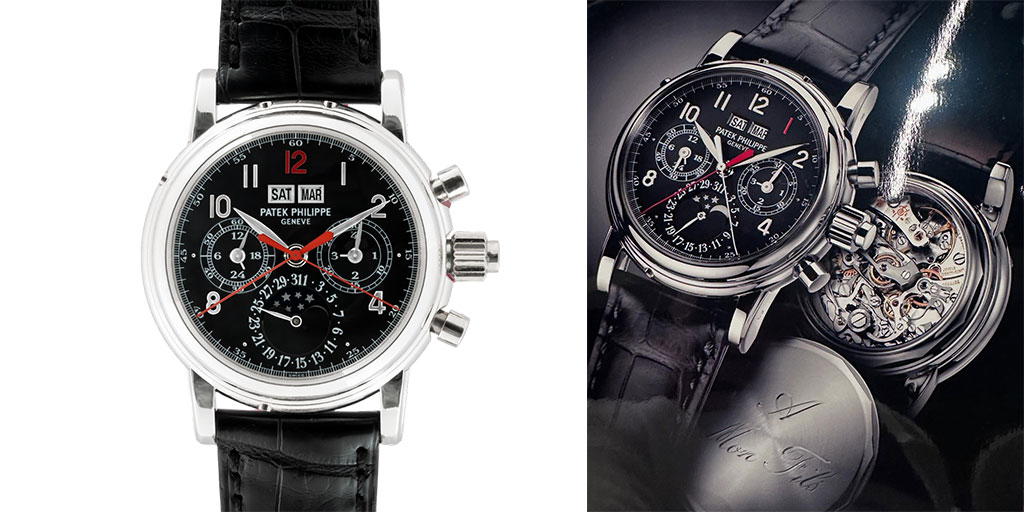
Image credit: Hodinkee (Salmon), Sotheby’s (Brown), Kinsmen (Red 12), @remyjulia_watch_specialist (Red 1)
Collectability and Market Analysis
Now that we have explored the ref. 5004’s features and which models have been made, we will explore the market for the split-seconds perpetual calendar. Our study focuses on all auction results from Antiquorum, Christie’s, Sotheby’s, and Phillips from 2000 to 2025. In this timeframe, the ref. 5004 has appeared 263 times at auction, representing 208 unique examples after removing duplicates across all metals and variants.
Production Numbers
While Patek Philippe initially communicated that twelve pieces were made per year, production evolved considerably over the sixteen production years. The resulting calculation of 12 × 16 = 192, which is sometimes seen is inaccurate and inconsistent with auction appearances.
Although introduced at Baselworld in 1994, the first models were only delivered in 1995. From approximately 2000 to 2004, production nearly ceased while the movement was being reworked. During this period, it was even speculated that the model had been discontinued. After 2004, production resumed and increased significantly.
Based on auction appearances (unique examples), the distribution by metal is as follows, excluding eight steel and one titanium:
| Christie’s | Sotheby’s | Phillips | Antiquorum | Total | Share | |
| Platinum | 38 | 22 | 16 | 15 | 91 | 46% |
| Rose gold | 23 | 5 | 7 | 8 | 43 | 22% |
| Yellow gold | 15 | 8 | 3 | 7 | 33 | 17% |
| White gold | 10 | 10 | 10 | 2 | 32 | 16% |
| Total | 86 | 45 | 36 | 32 | 199 | 100% |
While Patek Philippe will not confirm production numbers for the ref. 5004, based on auction appearances, and assuming approximately 20-25% of production appears at major auction houses over 25 years, we can extrapolate that total production was likely between 800 and 1000 pieces, with the following distribution by metal:
- Platinum: 350-450
- Rose gold: 160-220
- White and yellow gold: 120-160 each
- Steel: 50-80
- Titanium: 1
We can assume that approximately 80 to 120 first-generation ref. 5004 watches were produced from launch until 1998, though this number remains an estimate not confirmed by Patek Philippe.
Studying dial appearances for precious metals provides valuable insights into the model’s production. Dials have been categorized as silver, black (catalog and limited off-catalog series), and special orders as previously defined.
| Platinum | Rose gold | Yellow gold | White gold | Total | Share | |
| Silver | 48 | 26 | 28 | 16 | 118 | 59% |
| Black | 35 | 11 | 1 | 12 | 59 | 30% |
| Special orders | 8 | 6 | 4 | 4 | 22 | 11% |
| Total | 91 | 43 | 33 | 32 | 199 | 100% |
As expected, silver dials are the most common across all metals. The share of black dials is also quite high across all metals except yellow gold, given that only the diamond version was in the catalog. Lastly, these findings reflect the significant proportion of special orders made for the ref. 5004, which exceeds that of other models.
It should be noted at this stage that dial exchanges to accommodate client requests were a relatively common practice at the time, often performed by retailers, and were thus not always recorded. When performed by Patek Philippe, these swaps were usually recorded and are noted on the Extract from the Archives.
That said, a watch that left the Patek Philippe manufacture in a specific configuration or with a properly documented modification should command a premium over a watch that was subsequently modified without documentation. Collectors are highly encouraged to request an Extract from the Archives from Patek Philippe to make informed purchase decisions and understand the watch’s original configuration and history with confidence.
Market Analysis
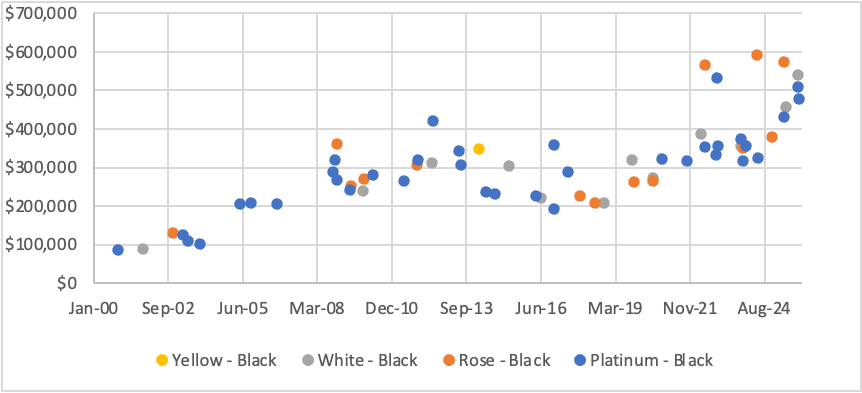
To provide better market understanding and clarity, auction results have been divided into three categories: silver dials, black dials (for precious metals), and steel, as results vary significantly among these groups. Special orders appear too infrequently to be comparable and have therefore been excluded from the graphs. The results include pieces sold multiple times, as they reflect market evolution. All prices include buyer’s premium and have been converted to USD with the exchange rate of the day of the auction.
It should be noted that currently, the market does not value first- and second-generation models differently, despite first-generation pieces being considerably rarer.
Silver Dials
Precious metal watches with silver dials have appeared 149 times at auction. The graph below shows the price evolution by metal. The data demonstrates a strong price increase since 2022, as collectors recognize the importance of the ref. 5004 and show appreciation for neo-vintage watches. Despite platinum being the most common metal, it tends to sell in the same price range as gold models. The last three-year average sale price for a ref. 5004 with a silver dial was $340,000 for platinum ($365,000 in 2025) and $338,000 for gold models ($416,000 in 2025, though based on only three sales).
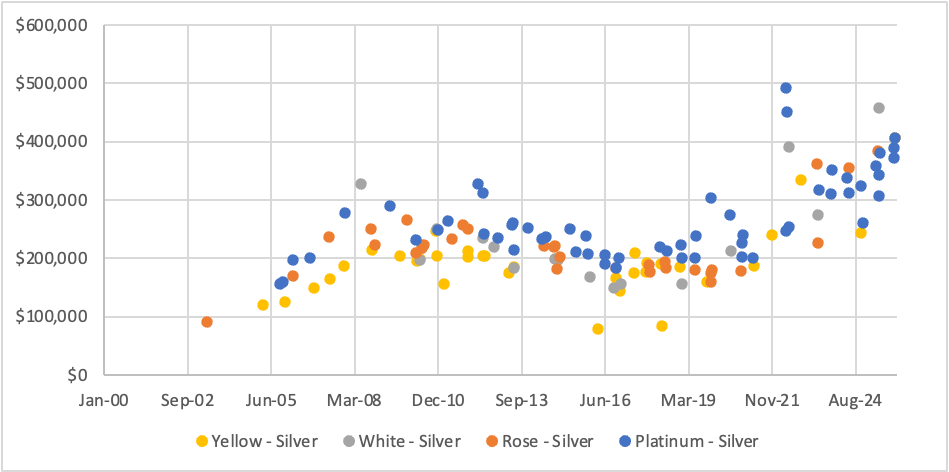
Black dials
Sixty-four watches with black dials have been sold across major auction houses. It is assumed that their total production is approximately half the production of watches with silver dials. Due to their relative rarity compared to their silver-dial counterparts, watches with black dials command a premium. In contrast, the rarer white- and rose-gold examples sell for more than platinum pieces. The last three-year average was $398,000 for platinum ($472,000 for 2025), $428,000 for white gold ($498,000 for 2025), and $473,000 for rose gold ($574,000 for 2025).
Steel
The steel model has appeared ten times at auction across major houses, representing eight unique examples. It commands a significant premium compared to regular precious metal models and sells in similar price ranges to notable special orders, with two of the last three sales exceeding $1 million.
Conclusion
The ref. 5004 represents a key chapter in Patek Philippe’s modern history – a watch that pushed technical boundaries while maintaining the manufacture’s classical aesthetic sensibility. Its journey from a challenging sale in the 1990s to a highly sought-after collector’s piece today reflects both the evolution of the watch market and a growing appreciation for the Philippe Stern era’s contributions to haute horlogerie.
As scholarship deepens and more examples surface, our understanding of this reference continues to evolve. The remarkable variety of special orders, the technical refinements across generations, and the watch’s role as a bridge to increasingly complex complications all contribute to its significance.
The dramatic price appreciation in recent years suggests collectors are finally recognizing what the ref. 5004 truly represents. With better information and a more complete picture of its production, the model will likely continue its ascent toward the place it deserves among Patek Philippe’s most important references.
Edouard Henn has been passionate about horology since his teenage years. He began his professional journey in the watch industry in Switzerland before transitioning to luxury retail across Europe and the Middle East. With a business education background, Edouard brings both product and collector’s perspective to his writing. Now based between Geneva and Paris, he enjoys sharing horological knowledge and connecting with fellow enthusiasts in the watch community.